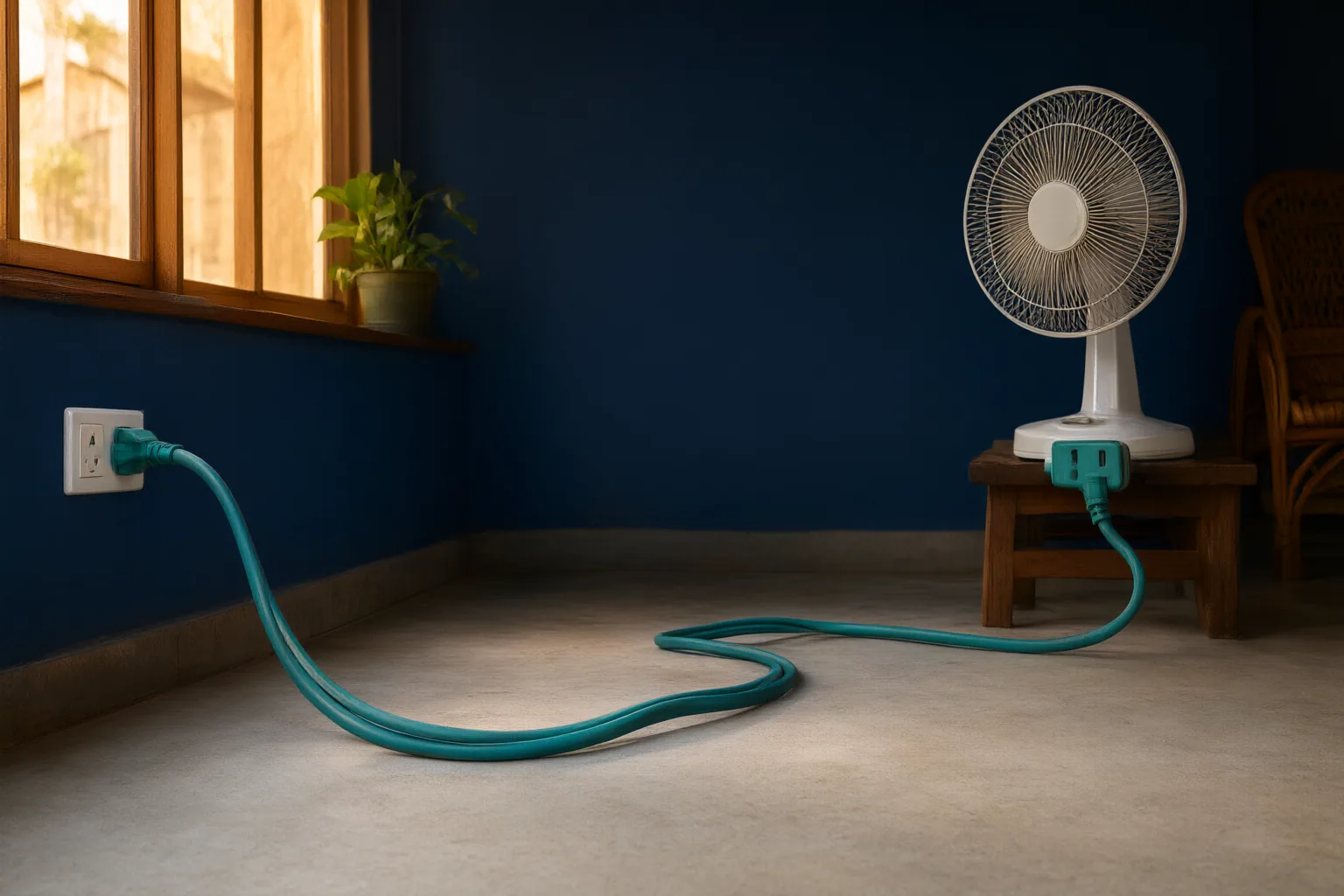
Choose an extension cord whose stated amp or watt capacity meets or exceeds the combined load of the connected appliances. Use the shortest suitable cord, inspect it before every use, keep it dry and uncovered, and disconnect it immediately if it becomes hot or repeatedly trips protection.
Choose a Cord That Can Carry the Intended Load
Start with the appliance labels and the markings on the extension cord. Add the wattage or amperage of everything you intend to connect, then confirm that the cord’s stated capacity meets or exceeds that total. Exceeding the rating can overheat the cord and create a fire hazard. Do not rely on appearance, outlet count or unsupported sales claims as evidence of capacity.
Length and conductor size also matter. A longer or thinner cord has greater resistance, which can contribute to voltage drop and heat buildup. Use the shortest cord that reaches safely, and select a heavier-gauge cord for a demanding load. Check the actual markings because gauge conventions and product descriptions can otherwise be confusing.
Do not place several high-draw appliances on one cord or multi-outlet strip. Limited backup-power outlets may make consolidation tempting during an outage, but the extension cord, strip and supply still have finite capacities. If the intended load cannot be supported within the marked ratings, reduce the number of connected appliances rather than adding another extension.
Set Up the Cord Safely During an Outage
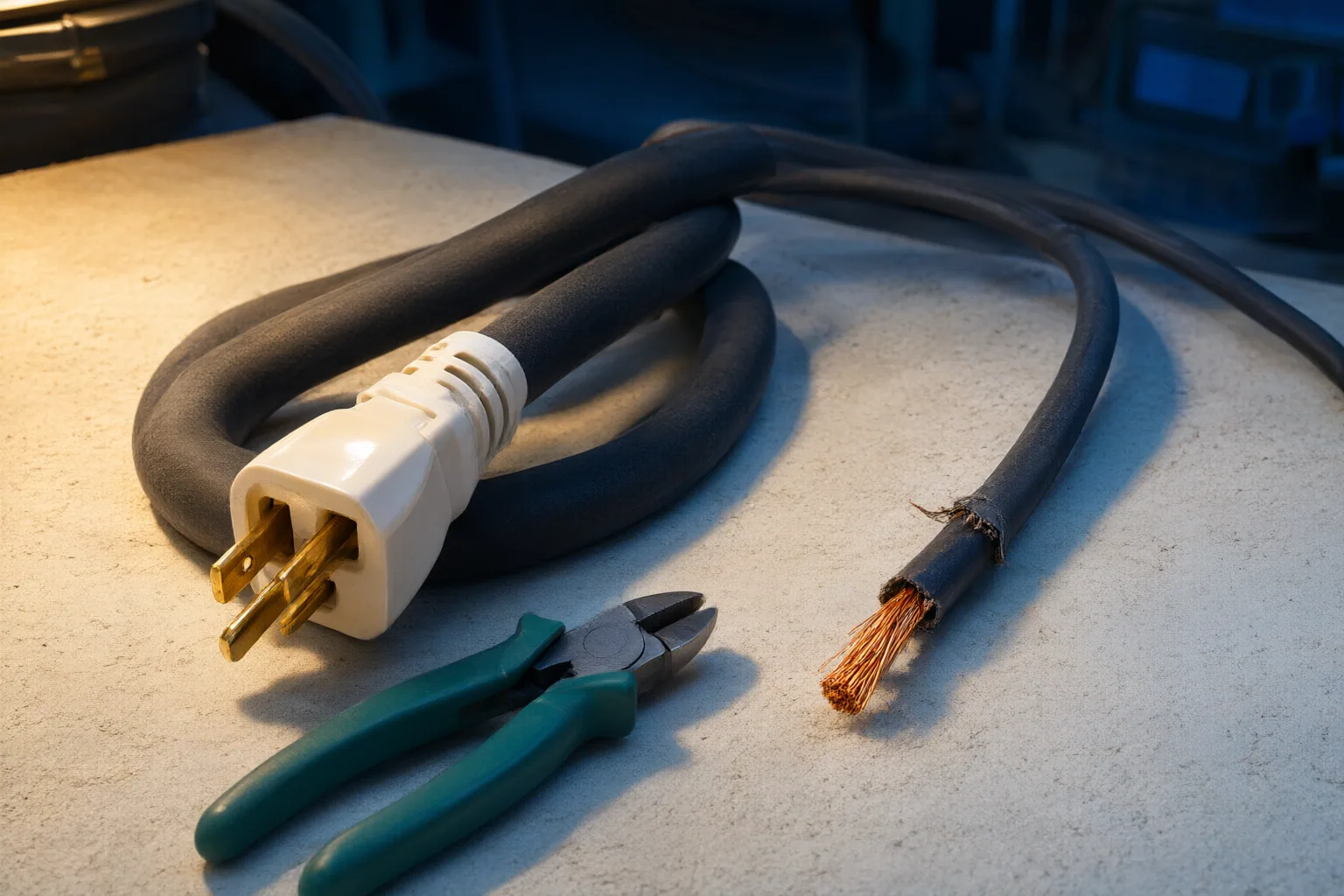
Inspect the full cord before connecting it. Remove it from service if the insulation is frayed, conductors are exposed, the plug is cracked, blades are bent, or a connection feels loose. A damaged cord should not be treated as acceptable simply because it still supplies electricity.
Match the cord to its surroundings. Keep an indoor-rated cord in a dry indoor location; a cord exposed to moisture, weather or abrasion must be appropriately rated for that environment. Never route a cord beneath a rug or bedding, where damage can remain hidden and heat can accumulate. Keep it away from doorways and walking routes, especially in dark rooms or areas used by children and pets, because crushing, tripping and insulation damage can create further hazards.
Do not connect extension cords end to end. Daisy-chaining creates additional connections and can encourage loads beyond what one cord or outlet can safely carry. Where more outlets are necessary, Nigerian wiring guidance favors distributing appliances appropriately and using an extension board with overload protection rather than chaining cords.
Extension cords are for temporary power needs, not substitutes for permanent household wiring. Repeated dependence on cords across rooms, inaccessible circuits or too few suitable outlets indicates that the fixed installation may need professional assessment.
Manage Overloads, Surge Risk and the Return of Grid Power
A multi-outlet power strip and a surge protector are not interchangeable. A basic strip mainly adds outlets; a surge protector is designed to help manage voltage spikes. Similar-looking housings do not prove that both provide the same protection, so check the device markings rather than assuming surge protection is included.
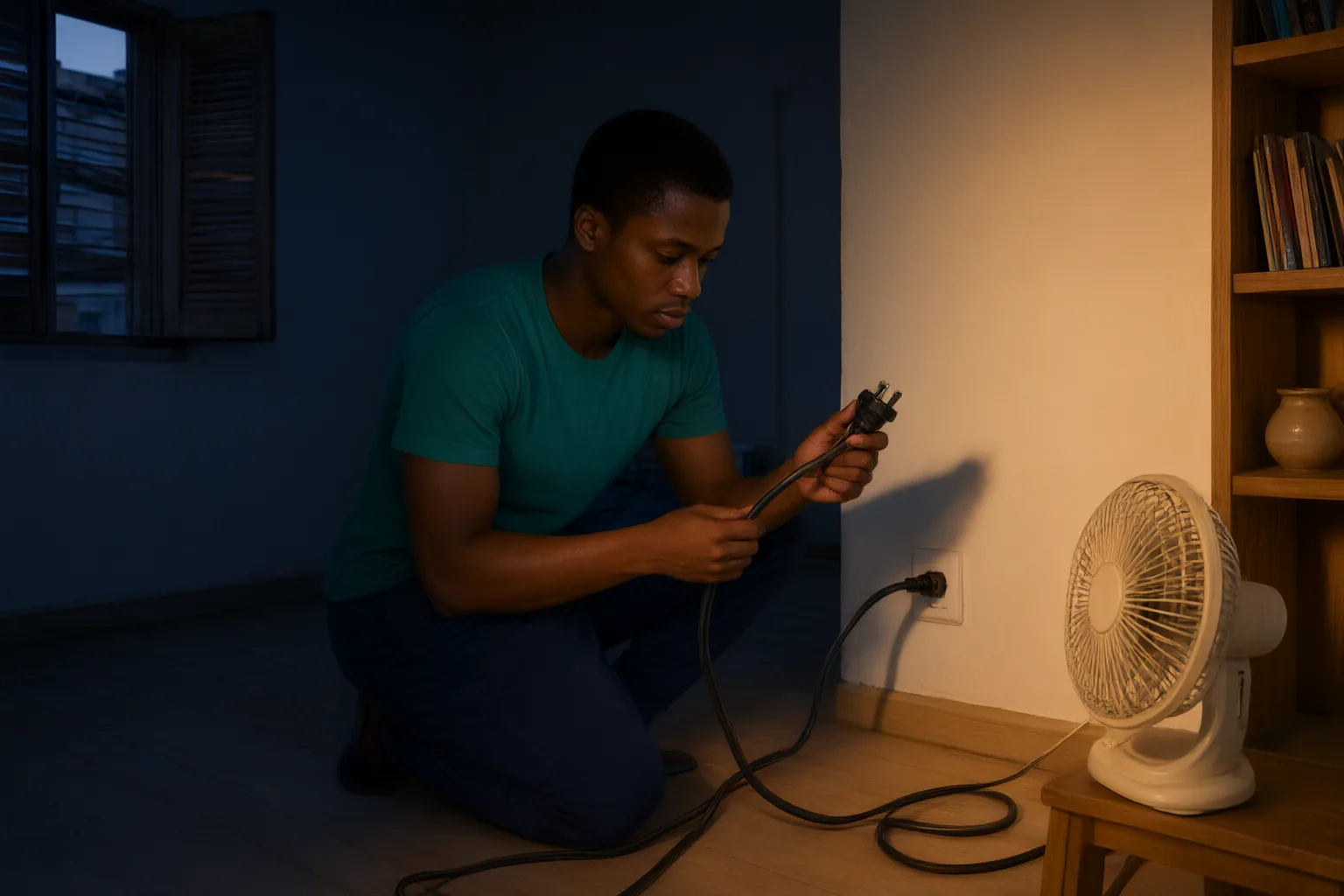
Treat heat or tripping as a warning. If a cord, adapter or strip becomes hot, disconnect the load and address the cause. If its breaker trips, do not merely reset it and resume the same arrangement. Reduce the load, recheck every rating and connection, and seek qualified help if the cause is unclear or the problem returns. High-draw appliances should not share a cord or strip with other heavy loads.
Nigeria-focused outage guidance recommends unplugging sensitive electronics and switching off heavy appliances when supply is interrupted. Suitable surge protection may help address voltage spikes when electricity returns, but it does not increase a cord’s load capacity or correct defective wiring. Reconnect equipment cautiously after supply is restored.
Safer fixed installations may include correctly selected circuit breakers, residual-current protection, surge protection and proper earthing. These measures serve different purposes and should be assessed as parts of the household installation rather than replaced by an extension cord.
Conclusion
Before the next outage, read each appliance label and cord marking, total the intended load, and use the shortest suitable cord with adequate capacity. Inspect its condition, keep it dry and uncovered, place it outside walking routes, and never daisy-chain it. Disconnect equipment if any connection becomes hot or protection repeatedly trips.
Remove damaged cords now. Ask a qualified electrical professional to investigate hot connections, repeated trips, inadequate fixed wiring, uncertain earthing or missing protective devices instead of relying on temporary extensions as a permanent solution.
Disclosures and limitations
- This article was prepared with AI assistance from the supplied source-backed research package. The underlying materials are secondary guidance rather than Nigerian regulator or manufacturer instructions, so readers should verify appliance labels, cord markings and applicable local requirements.
- No specific products, prices or performance claims are recommended here, and no affiliate product records were supplied. Commercial links, if added later, should be clearly disclosed and independently checked for suitability.
Related reading
- Electricity Consumers in Nigeria
- MW, MWh and GWh: How to Convert and Compare Nigerian Electricity Data
- What to Check When Your Nigerian Prepaid Meter Rejects Every Token After an Account Update
Sources
- Electrical Safety During Outages — Ready Home Plan
- Safety Rules for Electrical Wiring in Nigerian Homes and Offices – Service by Energymall — Service by Energymall
- How to Survive a Blackout in Nigeria | Power Outage Survival Guide — EcoFlow Nigeria
- Amazon.com : extension cords for appliances — amazon.com
- Extension Cord Safety | 20 Tips For Safe Extension Cords Use — HSE Blog
- How to Safely Use Extension Cords in Emergency Situations: Essential Safety Guidelines — ChaseDay.com
- Best Extension Cords For Appliances A Comprehensive Guide – TheSmallTools — TheSmallTools