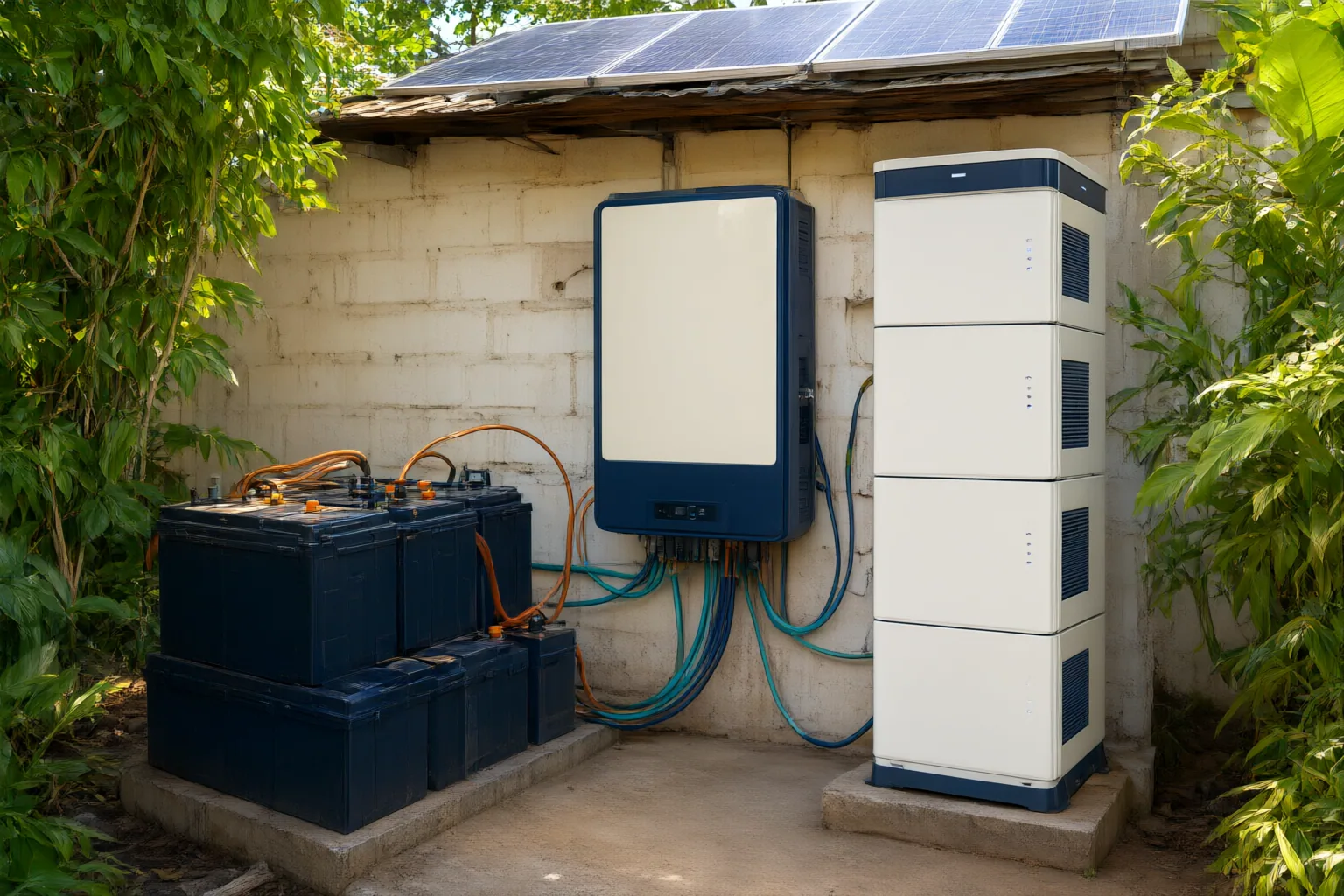
Compare solar batteries by usable capacity, construction and maintenance needs, stated cycle-life conditions, and compatibility with the exact charger or inverter—not by nominal capacity or upfront price alone.
Start With Usable Capacity, Not the Label Rating
A battery’s nominal energy rating does not necessarily show how much energy a household should plan to use. The permitted depth of discharge affects usable storage, so two batteries with the same label rating may not provide the same practical capacity.
A Nigeria-focused vendor guide illustrates this distinction with a lead-acid example: under its stated assumption that 50% of the bank’s capacity is usable, a household seeking 5 kWh of usable storage would need 10 kWh of total installed capacity. This is a worked vendor example, not a universal rule for every lead-acid battery. The appropriate depth of discharge depends on the specific product and the operating conditions stated by its supplier or manufacturer.
Begin by estimating the energy required to run selected household loads for the desired backup period. Then compare batteries using usable capacity calculated from each product’s documented depth-of-discharge guidance. Ask sellers to identify both nominal and usable capacity explicitly; otherwise, a battery with a lower purchase price or a larger-looking label may appear more capable than it is under its stated operating limits.
Compare Battery Type, Maintenance and Installation Needs
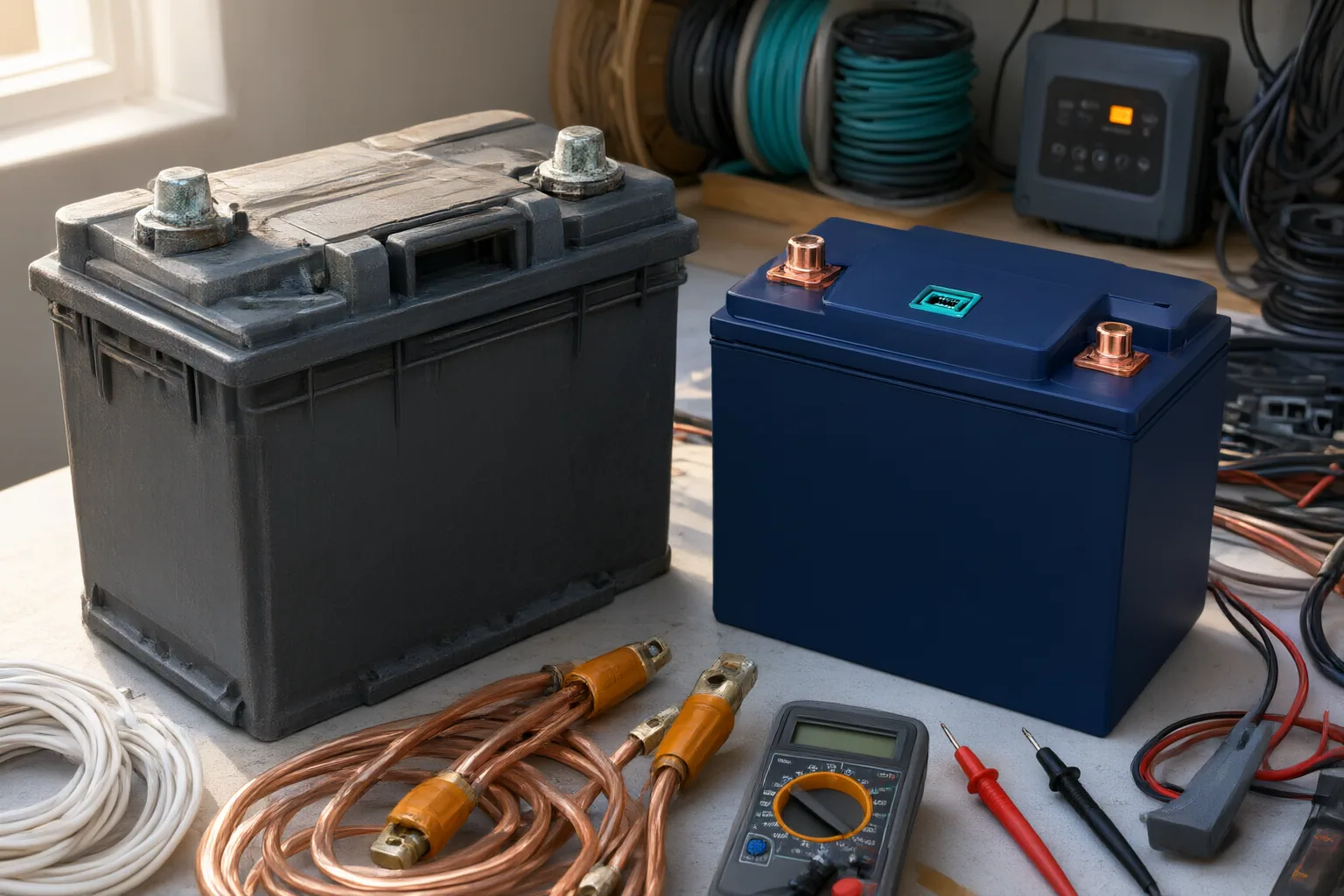
“Lead-acid” is not a complete description of a battery’s construction. The supplied sources separately identify flooded and sealed AGM lead-acid designs, while the lithium comparison discusses lithium iron phosphate, or LiFePO4. Households should therefore compare the precise type rather than treating every product within a broad chemistry category as interchangeable.
According to the Nigeria-focused vendor guide, flooded lead-acid batteries require water maintenance and ventilation. Those requirements affect placement, routine attention and the suitability of the installation area. The same guide describes sealed AGM batteries as maintenance-free, avoiding the water-maintenance requirement identified for flooded designs. That description should still be checked against the instructions for the exact product.
For lithium storage, the guide presents LiFePO4 as the relevant chemistry and says these batteries commonly include a battery management system for protection. Buyers should establish what protection the particular system provides rather than assuming every lithium-ion battery has identical controls.
Before comparing price, record each candidate’s full chemistry and construction, maintenance instructions, ventilation needs, installation restrictions and included protection equipment. This prevents an apparently simple lead-acid-versus-lithium comparison from overlooking important differences between flooded lead-acid, AGM and individual LiFePO4 products.

Check Cycle-Life Assumptions and Charging Compatibility
Cycle life can help frame long-term value, but a stated number is meaningful only with its test and operating conditions. Ask what depth of discharge, charging method, temperature and end-of-life threshold support any cycle-life claim. Also consider how the stated service life could affect replacement frequency instead of comparing batteries solely by upfront price.
The supplied evidence consists of commercial vendor pages and does not independently verify the vendor’s numerical lifespan or cost claims. It therefore cannot establish a general cycle-life benchmark for lead-acid or lithium-ion batteries. Treat broad figures as claims to confirm in the exact manufacturer datasheet, warranty terms and supporting documentation—not as guaranteed household outcomes.
Charging compatibility also requires model-level verification. The supplied catalogue confirms that both lead-acid and lithium-ion batteries are offered for solar storage, hybrid and off-grid systems, but it does not provide individual models’ charging voltage, charging current, temperature or cutoff limits. No universal charger setting can be derived from these sources.
Request the approved settings for the exact battery and confirm that the proposed inverter or charge controller can apply them. Where a LiFePO4 system includes a battery management system, its presence does not remove the need to verify charger compatibility and installation requirements.
Conclusion
Use a product-by-product checklist. First, calculate the usable storage needed for the household’s selected loads and backup period. For every candidate, record nominal capacity and documented depth of discharge. Identify whether a lead-acid product is flooded or AGM, then account for stated water-maintenance, ventilation and placement requirements. For LiFePO4, establish which battery-management protections are included.
Next, examine the conditions attached to cycle-life claims and consider possible replacement frequency without treating unverified vendor figures as universal benchmarks. Finally, match the battery’s documented voltage, current, temperature and cutoff requirements to the proposed charger or inverter.
Before purchasing, obtain the exact battery datasheet and ask a qualified solar installer to confirm its depth-of-discharge guidance, cycle-life conditions and charging settings against the complete household system.
Disclosures and limitations
- This article was prepared with AI assistance using the two cited commercial vendor sources. Their performance, lifespan and cost claims are not independent laboratory findings and should be checked against product datasheets and other authoritative documentation.
- No specific product is recommended here. Readers should verify any seller or publisher affiliate relationship before purchasing, because commissions can create a financial incentive.
Related reading
- Renewable Energy in Nigeria
- How to Verify Solar Panel Wattage Ratings Before You Buy in Nigeria
- How Nigerian Households Can Compare Solar Installer Quotations
Sources
- Lithium vs Lead Acid Solar Batteries in Nigeria: Which Is Better for Your Solar System? (2026 Guide) — Titanium Power Solutions
- Products – Classic Power Batteries Trading — Classic Power Batteries Trading