
Compare solar installer quotations by first defining the household’s energy needs, roof constraints, goals and budget, then transferring every proposal into the same table. Review total cost, panels, inverter, warranties and financing alongside the assumptions used to size the system. Ask for written explanations wherever quotations use different inputs or performance claims.
Start with household needs and system-sizing inputs
A useful comparison begins with the household, not with a panel ranking. Record household energy consumption, available roof area, energy goals and budget before assessing the proposed equipment. These factors can influence which equipment and system size may be suitable, so two quotations should not be treated as equivalent merely because they promise a broadly similar outcome.
Ask each installer to identify the inputs behind the proposed system size. Compare those inputs before comparing component quantities. If the proposals start from different estimates of household consumption or use different assumptions about the usable roof area, their component sizes and performance expectations may also differ.
The available evidence does not provide a Nigeria-specific method for normalising load estimates, solar-resource assumptions, battery-autonomy targets or component derating. Households should therefore avoid silently substituting their own benchmark. Instead, list each installer’s assumptions side by side, mark anything that is missing and request a written explanation of material differences. This does not establish which proposal is correct, but it helps prevent unlike systems from being compared as though they were designed on the same basis.
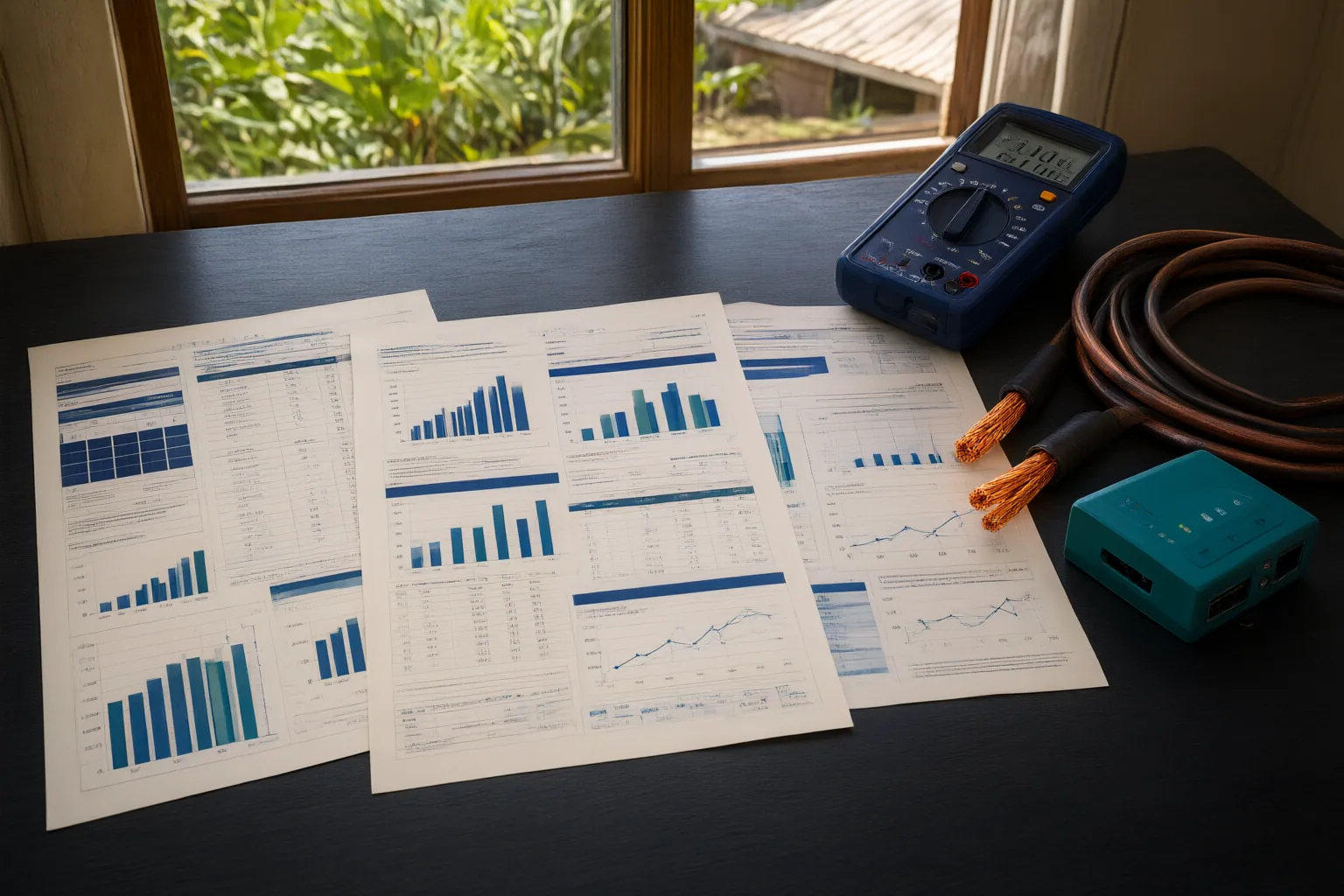
Put every quotation into the same comparison table
Transfer the quotations into a single table rather than relying on each installer’s layout. SolarProGuide recommends comparing written quotations side by side on cost, panel brand, inverter, warranty and financing. Using common fields makes differences and omissions easier to see without assuming that a particular brand, price or payment structure is better.
Create one column for each quotation and rows for:
- Total system cost
- Panel brand and the proposed panel details
- Inverter
- Warranty coverage stated in the quotation
- Financing terms, where offered
- Household and sizing inputs supplied by the installer
- Items that are absent or require clarification
Preserve the wording and units used in each proposal. Do not combine unlike figures into a single number unless the installer explains that they represent the same measure. A lower total cost, for example, is not a complete comparison if the proposed equipment, warranty or financing arrangement differs.
Use the table to generate questions rather than an automatic winner. Ask an installer to fill in missing fields and explain why its configuration differs from another proposal. Keep those responses with the written quotation so that the final decision reflects documented terms rather than a verbal summary. The retained source recommending quote comparison is a commercial referral service, so its framework should not be read as independent verification of installer quality or savings.

Compare component specifications and performance claims carefully
Panel proposals can differ in rated wattage, efficiency, temperature coefficient and the output retained under a production warranty. Place each of these specifications in a separate row and record the stated unit, warranty period or condition exactly as presented. This keeps a higher headline wattage from being mistaken for a complete assessment of the proposal.
Separate published component specifications from assumptions made by the installer. CNET’s panel evaluation relied on publicly available manufacturer specification sheets rather than in-person testing, illustrating the distinction between reviewing documentation and verifying real-world performance. When an installer presents a performance figure, ask whether it comes from a published specification or from assumptions used to design the household system.
Read warranty information alongside the relevant component specification. A production warranty concerns retained output, while the quotation may contain other warranty language that needs to be compared on its own terms. Do not treat the mere presence of a warranty as evidence that two proposals offer equivalent coverage.
Equipment should also be assessed against the household’s energy goals and budget rather than a headline ranking alone. CNET says installer selection may matter more than choosing the highest-ranked equipment. The supplied sources, however, do not verify any Nigerian installer’s credentials or expected system performance. The defensible step is therefore to document specifications, identify inconsistent assumptions and request clarification—not to infer quality that the evidence does not establish.
Conclusion
A disciplined solar quote comparison has four stages: document the household’s consumption, roof constraints, goals and budget; put every quotation into identical fields; compare component specifications and warranty language; and obtain written explanations for different sizing or performance assumptions.
This process can expose omissions and show where proposals are not directly comparable, but it cannot answer every local question. The retained sources are focused on the United States and do not establish Nigerian prices, installer credentials, incentives, financing terms, regulations or expected system performance. They also do not supply a Nigeria-specific formula for reconciling different load, solar-resource, battery-autonomy or derating assumptions.
Before choosing a proposal, complete the side-by-side comparison sheet, send unresolved questions to each installer and resolve every material difference in writing.
Disclosures and limitations
- This article was prepared with AI assistance from the supplied research package and was not based on personal product use, testing or installer interviews.
- The cited sources include US-focused material and a commercial quotation-referral service; no affiliate relationship, Nigerian installer quality, local price or expected performance was established by the supplied evidence.
Related reading
- Renewable Energy in Nigeria
- How to Approach Renewable Energy Cost Comparisons Across Currencies and Price Years
- How Dangote Petroleum Price Reductions Could Affect Generator vs Solar Costs in Nigeria