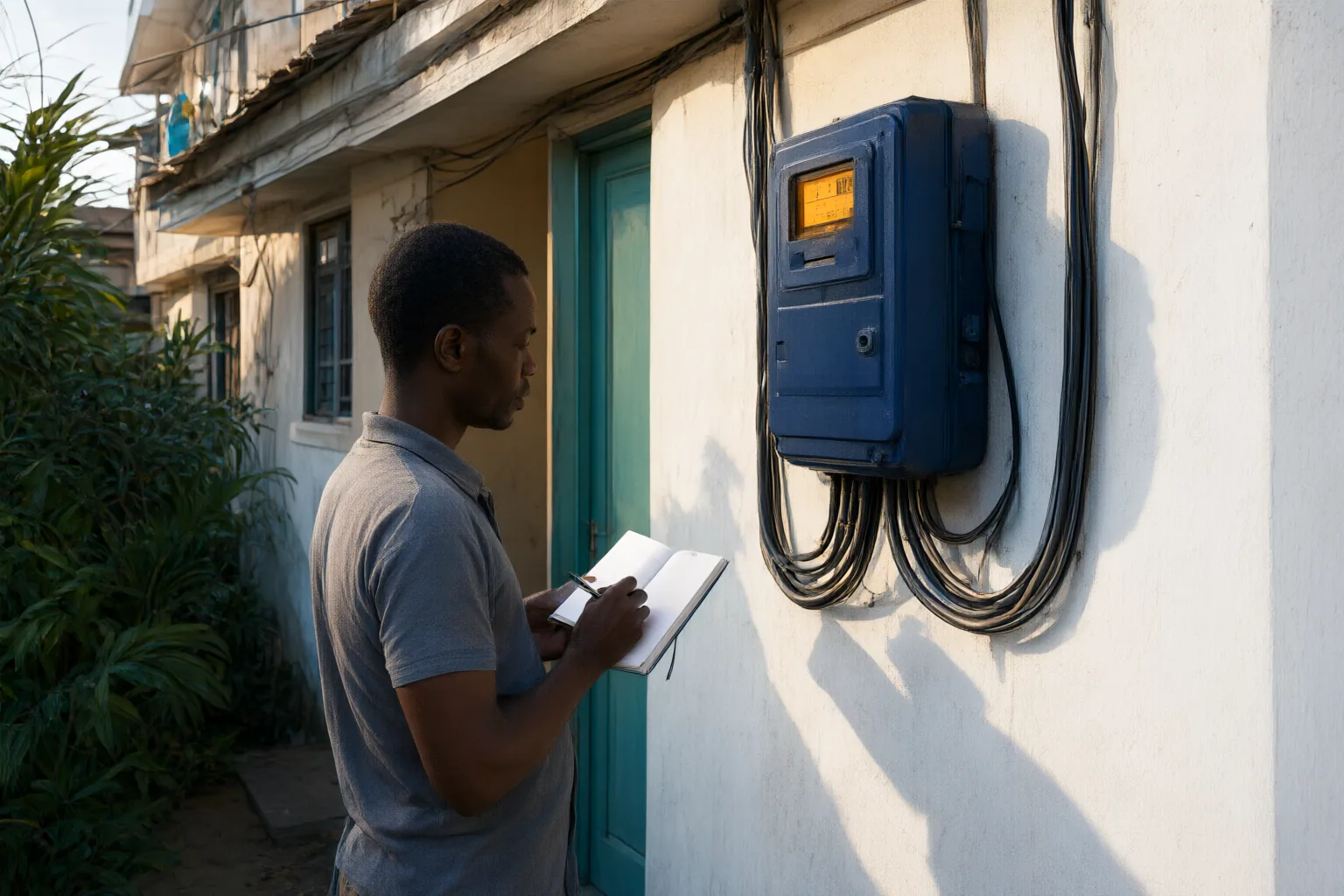
When several households share one electricity meter, fair allocation depends on making each unit’s consumption verifiable. Residents and landlords can document the current mismatch, then compare individual meters, sub-metering and compatible monitoring tools while recognising their costs and evidentiary limits.
Why shared-meter electricity charges cause disputes
A collective electricity charge shows what the building owes but may not reveal how much power each household used. Without unit-level records, residents cannot independently check whether their assigned shares reflect relative consumption. Disagreements can therefore recur even when everyone accepts the total charge.
The reports describe an Agege, Lagos, resident who shared a meter with several households. Disputes about who consumed more electricity contributed to his decision to obtain an individual smart meter. The example illustrates the central problem: an allocation can appear unfair when there is no separate usage record against which to test it.
The consequences can extend beyond arguments among neighbours. The reports say landlords may be left with unpaid electricity charges after tenants move out, while disconnection and reconnection fees can increase their costs. A more verifiable arrangement can therefore matter to residents, landlords and property managers alike. The supplied sources, however, do not establish an official allocation formula, legal remedy or regulatory dispute process.

Start by documenting the allocation problem
Before considering new equipment, affected households and the landlord can identify precisely what the present arrangement fails to show. Keep the collective charge and record the amount assigned to each unit for the same period. Note which allocations are disputed and whether any household-level usage record exists. This does not prove what each household consumed, but it makes the verification gap visible.
Discussion should focus on that gap rather than unsupported estimates about which neighbour uses the most power. Residents can ask what evidence currently connects each assigned amount to consumption and whether the same approach is being applied consistently. The objective is to define the problem that a different arrangement would need to solve: producing a separate, reviewable record for each unit.
This is practical guidance derived from the reported source of shared-meter disputes. It is not an official complaint procedure or a statement of legal rights. The sources supplied for this article do not provide verified escalation steps or a prescribed method for dividing a collective charge.

Compare individual meters, sub-metering and monitoring software
The reports present individual metering and sub-metering as two ways to create household-level records. In the Agege example, a resident obtained his own smart meter after disagreements under a shared arrangement. The reports also describe a landlord who introduced sub-metering so every housing unit had an individual usage record and bill; he said disputes ended almost immediately. That reported experience is useful evidence of a possible benefit, but it does not establish that the same outcome will occur in every property.
Residents and landlords should distinguish the options. An individual meter separates a household from the shared record in the reported example. Sub-metering retains a building-level arrangement while adding unit-level records, as described in the landlord’s case. The available material does not provide installation rules, technical requirements, allocation formulas or comparative pricing, so those details should not be assumed.
Cost is a material constraint. The reports say the upfront cost associated with smart meters can discourage households already under financial pressure. Any discussion should therefore consider whether the chosen approach is financially feasible for the affected residents and property owner, without assuming a particular price or funding arrangement.
The reports also relay Vendr.ng’s claim that owners of compatible Wi-Fi-enabled prepaid meters can connect existing devices to its cloud platform for consumption monitoring and remote recharge without buying the company’s proprietary hardware. This is a vendor claim reported by the sources, not independently tested product evidence. Compatibility, performance and security specifications were not supplied. Both reports also say it remains uncertain whether software-based services can reduce shared-billing disputes at scale, especially in Nigeria’s informal housing sector. The two reports substantially overlap, so their similar accounts should not be treated as fully independent corroboration.
Conclusion
The clearest evidence-supported direction is to replace an unverifiable division of a collective charge with a record that links consumption to each unit. The reported examples suggest that an individual meter or unit-level sub-metering can make usage more visible, while monitoring software may be relevant only where existing meters are compatible and vendor claims are verified.
The sources do not establish legal entitlements, official escalation procedures or a universally fair allocation formula. Residents should therefore avoid treating estimates as measured consumption. Before the next billing cycle, ask the affected households and landlord to document the current charge and allocations, compare feasible individual-meter and sub-metering arrangements, and agree on how future charges will be tied to recorded unit-level usage.
Disclosures and limitations
- This article was prepared with AI assistance from the two supplied reports; those reports substantially overlap, and vendor capabilities mentioned above were not independently tested.
- No affiliate relationship was disclosed in the supplied material. Mention of Vendr.ng is source-led reporting of a vendor claim, not a product endorsement or purchase recommendation.
Related reading
- Electricity Consumers in Nigeria
- Nigeria’s 2026 Electricity Meter Rollout: What the Reported 60% Coverage Means for Consumers
- What Akwa Ibom’s Electricity Regulatory Transfer Means for Tariffs, Complaints and PHEDC Customers