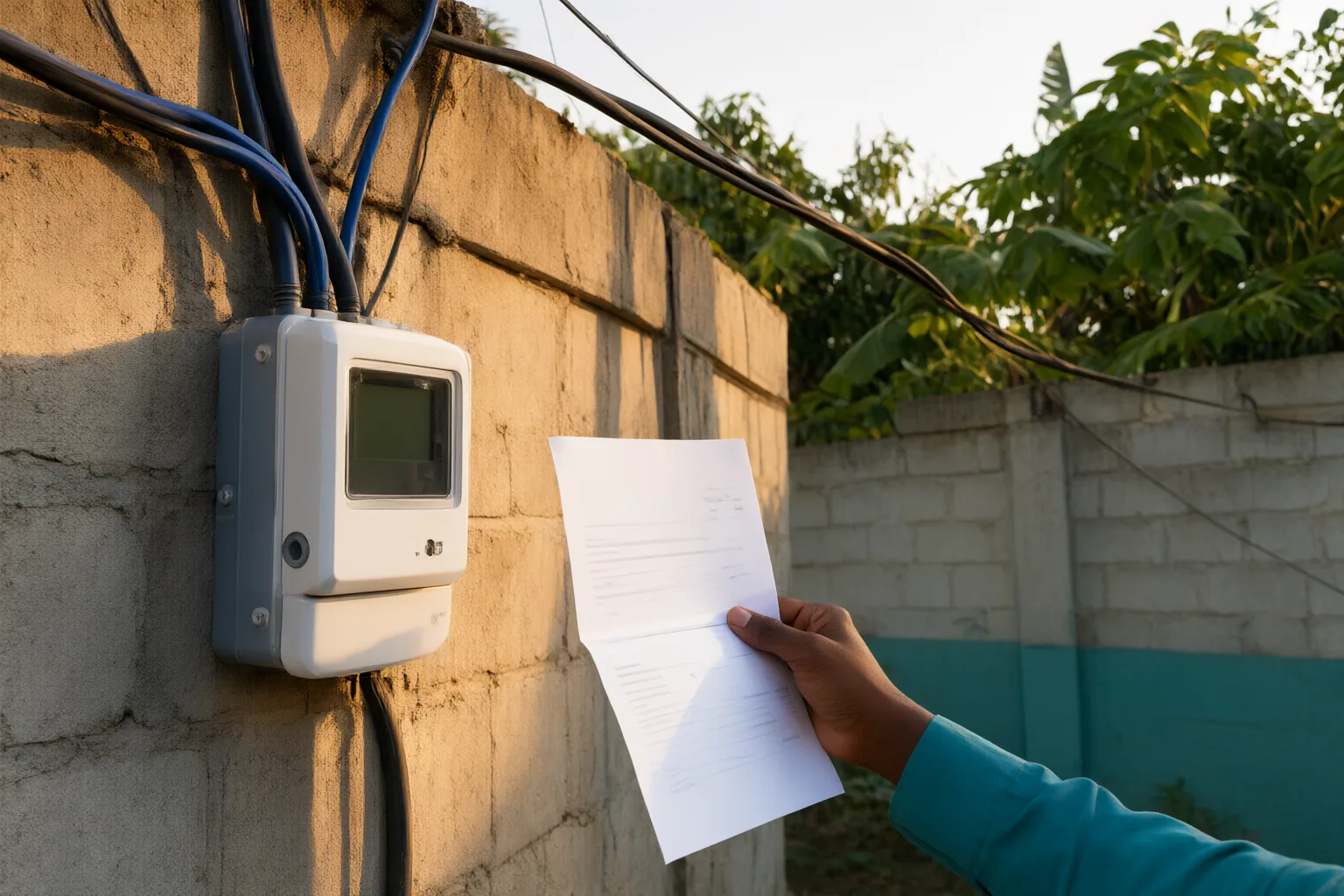
Electricity-bill verification means looking beyond the amount due. Consumers can compare the consumption context, tariff type, service classification and resulting charges, then confirm them against current official information. The available evidence provides useful concepts and historical context, but it does not establish today’s Nigerian rates, bill format or meter-verification procedure.
What billing verification can establish
A bill review can help establish whether its main elements appear internally consistent. The total alone is not enough: the recorded consumption context, applicable tariff design and resulting charge all matter. Residential tariffs can take several forms, including a fixed unit rate, tiered pricing, time-of-use pricing, demand charges, seasonal pricing, or different weekend and holiday rates. A meaningful comparison therefore starts by identifying which structure the bill applies rather than assuming every unit is charged in the same way.
Tariffs may also differ between countries or regions because of generation costs, taxes or subsidies, weather, transmission and distribution infrastructure, and regulation. Published comparisons require careful reading as well. For example, the visible summary of a Statista page says its Nigerian figures are calculated using assumed average annual household consumption and annual business consumption of 1,000,000 kWh, with rounded results; that summary supplies no specific prices.
These sources do not document Nigeria’s current bill layout, official rates or prescribed meter-checking method. They consequently support a framework for reviewing a bill, not a finding that any particular charge is correct or incorrect.
Service bands and tariff factors: historical context
A September 2020 BBC News Pidgin report provides historical context for service-based billing in Nigeria. It reported that a service-reflective tariff took effect on September 1, 2020 and divided distribution customers into five service bands, A through E. The report described the bands as corresponding to daily supply of 20 hours for A, 16 hours for B, 12 hours for C, eight hours for D and four hours for E. It also said Bands D and E were not affected by that round of tariff adjustment.
The same report identified several considerations in tariff setting at the time: inflation, gas prices, exchange rates, distribution companies’ average sales, the unit cost of generation, and technical, collection and commercial losses. These factors help explain why a charge cannot necessarily be assessed from consumption in isolation.
The report also recorded consumer concern about affordability and linked the fairness of higher bills to actual supply duration and reliability. That makes the relationship among service classification, delivered supply and billing a relevant point for scrutiny. However, every band description and tariff factor above comes from reporting published in 2020. The evidence supplied here does not show that the classifications, thresholds or treatment remain unchanged in 2026, and it contains no current price table. Consumers should treat this material as background and verify present rules through current official distributor information.
Two billing-verification FAQs
The two questions below address the central limits of bill comparison. First, tariff structures vary, so a change in the total cannot by itself reveal whether the difference comes from consumption context, classification or the applicable charging design. Second, the available Nigerian service-band evidence dates from 2020 and cannot establish current rules.
This distinction is important when consulting published datasets. A displayed figure may depend on assumed annual consumption and rounding rather than matching an individual account. The supplied Statista summary illustrates that limitation but provides no numerical tariff that could be used to calculate or validate a Nigerian bill. Verification should therefore keep general concepts, historical reporting and current account-specific information separate.
Conclusion
Nigeria electricity billing verification is best approached as a comparison of related elements, not merely a check of the final amount. The evidence supports examining the consumption context shown on the bill, identifying the tariff type, noting the stated service classification and considering whether billed service appears consistent with actual supply. General tariff categories clarify why pricing methods matter, while the 2020 service-band report shows why supply duration and classification have been important to consumers.
The evidence does not supply current rates, a present-day bill template, a formal reading-validation method or a complaint procedure. It therefore cannot settle an individual billing dispute. Compare the usage period, tariff classification and charges on your latest bill with current official information from your electricity distributor, and request clarification if the classification or billed service appears inconsistent.
Disclosures and limitations
- This article was prepared with AI assistance using only the supplied research package. Its factual basis is limited to the identified BBC News Pidgin, general tariff-structure and Statista-summary sources, with historical and current information explicitly separated.
- No products are recommended and no affiliate relationship is presented. Current rates, classifications and billing procedures should be confirmed with an official electricity distributor source.
Related reading
- Data & Reports for Nigeria’s Electricity Sector
- Nigeria Electricity Service Quality: What Consumers Can Assess and Verify
Sources
- New electricity tariffs in Nigeria 2020 hike for kilowatt unit of energy frustrate pipo from Ikeja to Abuja – See how much you go pay now & why NERC announce sudden hike – BBC News Pidgin — BBC News Pidgin
- Electricity pricing – Wikipedia — en.wikipedia.org
- Electricity prices by user group in Nigeria 2025| Statista — Statista
- Electricity Act, 2003 – Wikipedia — en.wikipedia.org