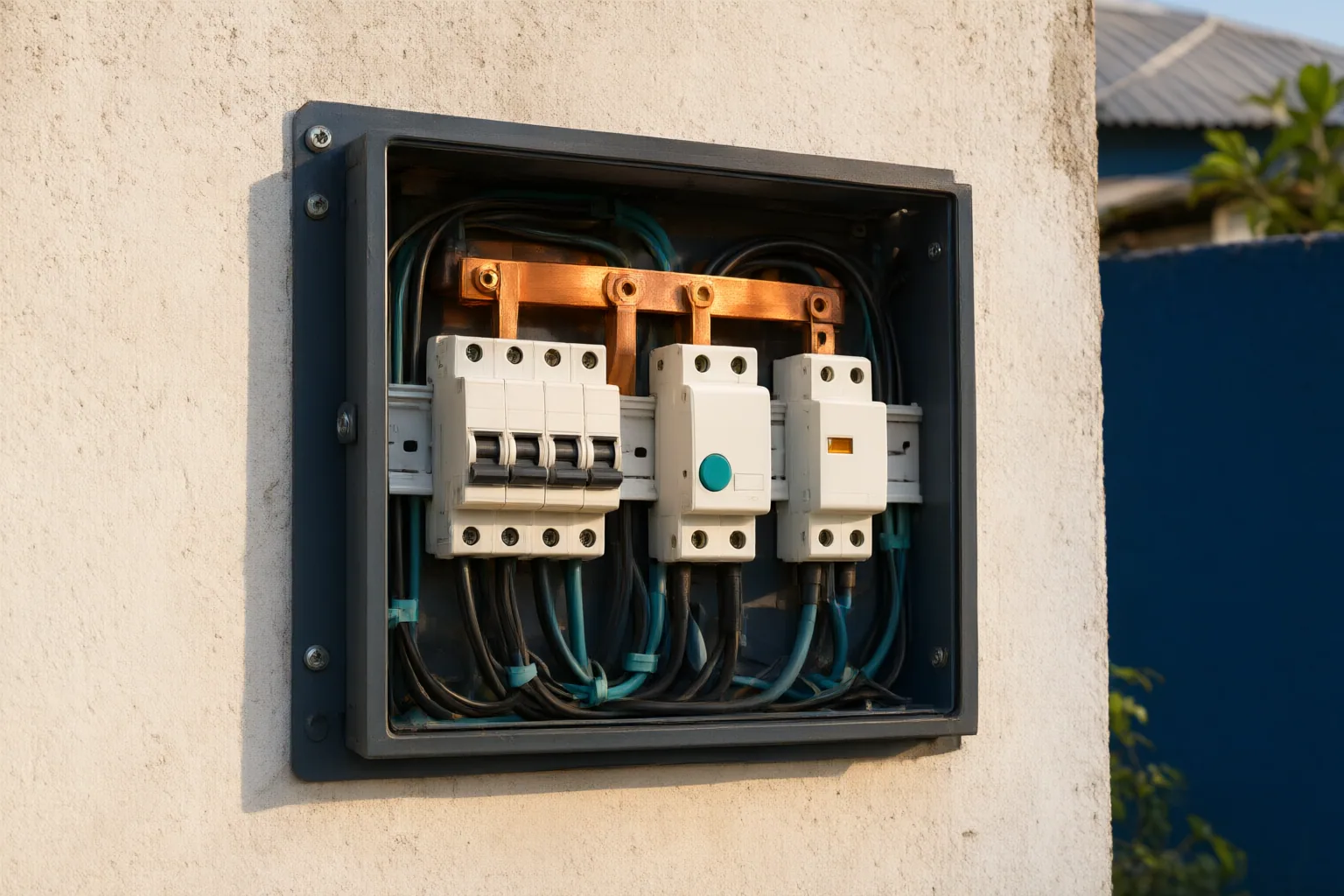
Circuit breakers (MCBs) interrupt overload and short-circuit faults, while earth-leakage devices such as ELCBs, RCCBs and RCDs detect current leaking to earth and trip within milliseconds at sensitivities such as 30 mA. Surge protectors address a third problem, voltage surges, which the sources cited for this article do not cover, so this explainer bounds its claims to the first two categories.
What Each Protective Device Does: Overcurrent vs Earth-Leakage vs Surge
A miniature circuit breaker (MCB) is an overcurrent device: it interrupts a circuit when overload or short-circuit conditions appear. An earth-leakage device does a different job. It responds to leakage current — an ELCB senses fault currents between the line and earth conductors within the portion of the installation it protects, and when sufficient fault characteristics appear across its sensing mechanism, it switches the power off and stays off until manually reset. Modern residual current devices (RCDs and RCCBs) detect imbalances between the live and neutral currents, with typical trip sensitivities of 30 mA, 100 mA or 300 mA, and they trip within milliseconds.
Because ELCBs and RCCBs offer no protection against overloading or short circuit, they must be used in series with an MCB. Surge protectors are a separate category again: the research sources used for this article do not address surge protectors, SPDs or voltage-surge protection, so this explainer makes no claims about how they behave.
Why the Names Are So Confusing: ELCB, RCCB, RCD and GFCI
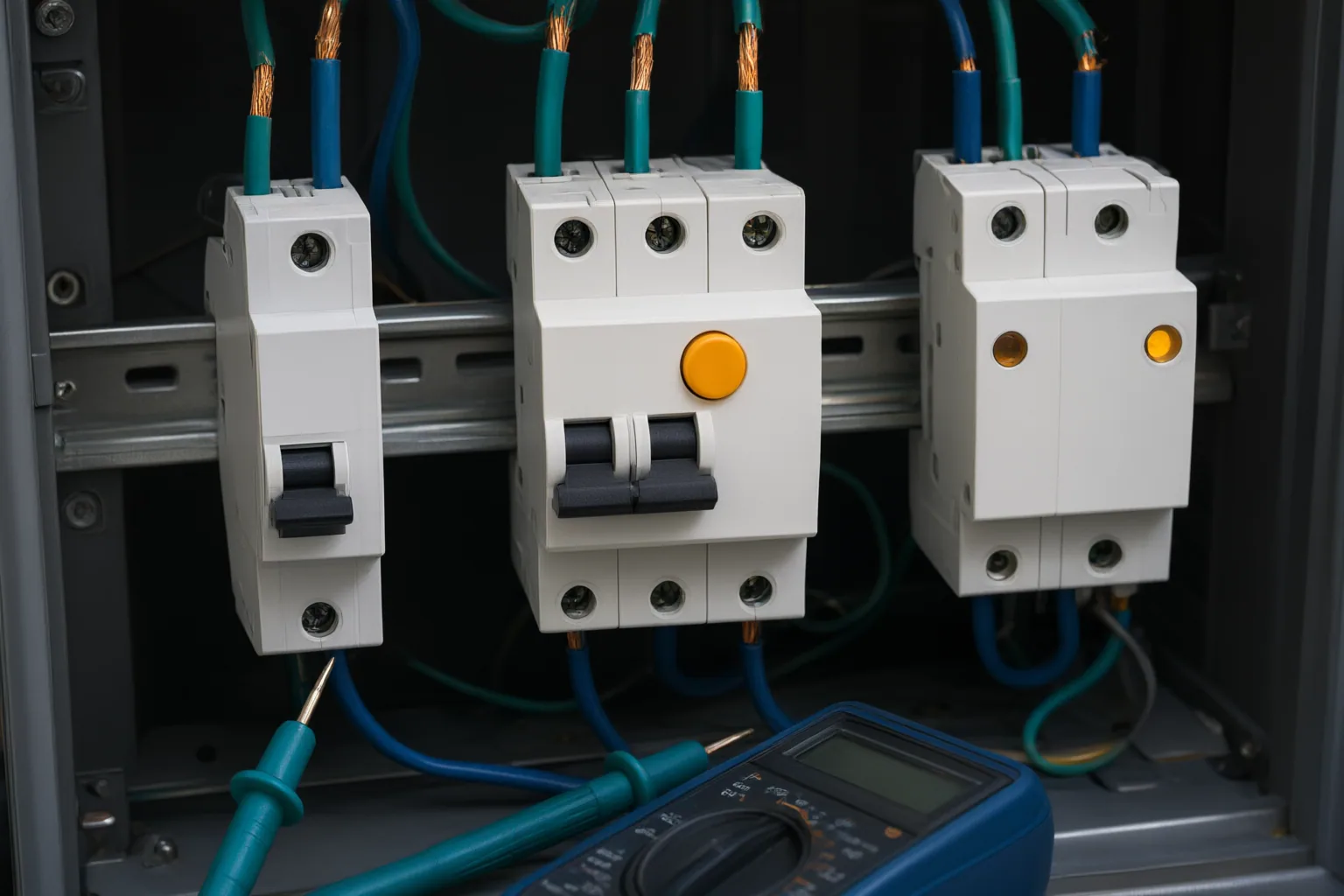
The names are genuinely tangled. Early earth-leakage circuit breakers were voltage-operated; they were later replaced by current-sensing devices, and for a time both types were called ELCBs. That overlap prompted the IEC to introduce the term residual current device (RCD). In modern usage, ELCB is sometimes reserved for the older voltage-operated type, while current-sensing devices are labelled RCD, RCCB or GFCI — which is why two similar-looking units in one distribution board can provide quite different protection.
The older voltage-operated ELCB detects a potential rise between the protected interconnected metalwork and a remote reference earth electrode, operating at a detected potential of around 50 volts. Its weaknesses are documented: a wire break in the earth connection can disable operation, and additional earth connections on the protected system can prevent detection. Critically, it cannot detect current leaving a live wire and running to ground by another path, such as through a person standing on the earth — a key reason these devices largely fell out of favour after current-sensing RCD (GFCI) technology was invented.
How Earth-Leakage Protection Works and Which Combinations Protect You
Modern earth-leakage protection works on the core-balance principle. The conductors of a circuit pass through a current transformer; under normal conditions the vector sum of the currents is zero and no flux is induced. An earth fault creates an imbalance, which energizes a relay and trips the circuit breaker.
Sensitivity decides what is protected. Leakage current flowing to earth through a person's body can be fatal above about 30 mA, so standard devices trip at 30 mA — below thresholds associated with involuntary muscle contraction. One manufacturer, citing IEC 1008/1009, describes 30 mA (tolerance 15–30 mA) as suitable for domestic and personal protection, and higher sensitivities of 100–375 mA for circuits with less chance of direct contact, giving reasonable protection against electrical fires; 100/300 mA ratings are described for fire protection in industrial settings.
Combinations matter as much as devices. An RCD provides no overcurrent protection, so it must be paired with an MCB or fuse; an RCBO combines residual-current detection with overload and short-circuit protection in a single unit, saving distribution-board space, though it is described as more expensive than standalone RCDs or ELCBs. Placement counts too: earth-leakage protection is installed at the consumer unit where power enters the property, immediately after the meter, and splitting an installation into separately protected circuits means a fault trips only the affected circuit.
Conclusion
The distinctions are easy to hold on to. Circuit breakers handle overcurrent — overloads and short circuits. Earth-leakage devices (ELCB, RCCB, RCD) handle leakage to earth, with 30 mA units guarding people against shock. Surge protection is a separate function that the sources cited here do not address, so treat any surge-protector claim as needing its own evidence. No single device covers every fault, which is why installations combine them.
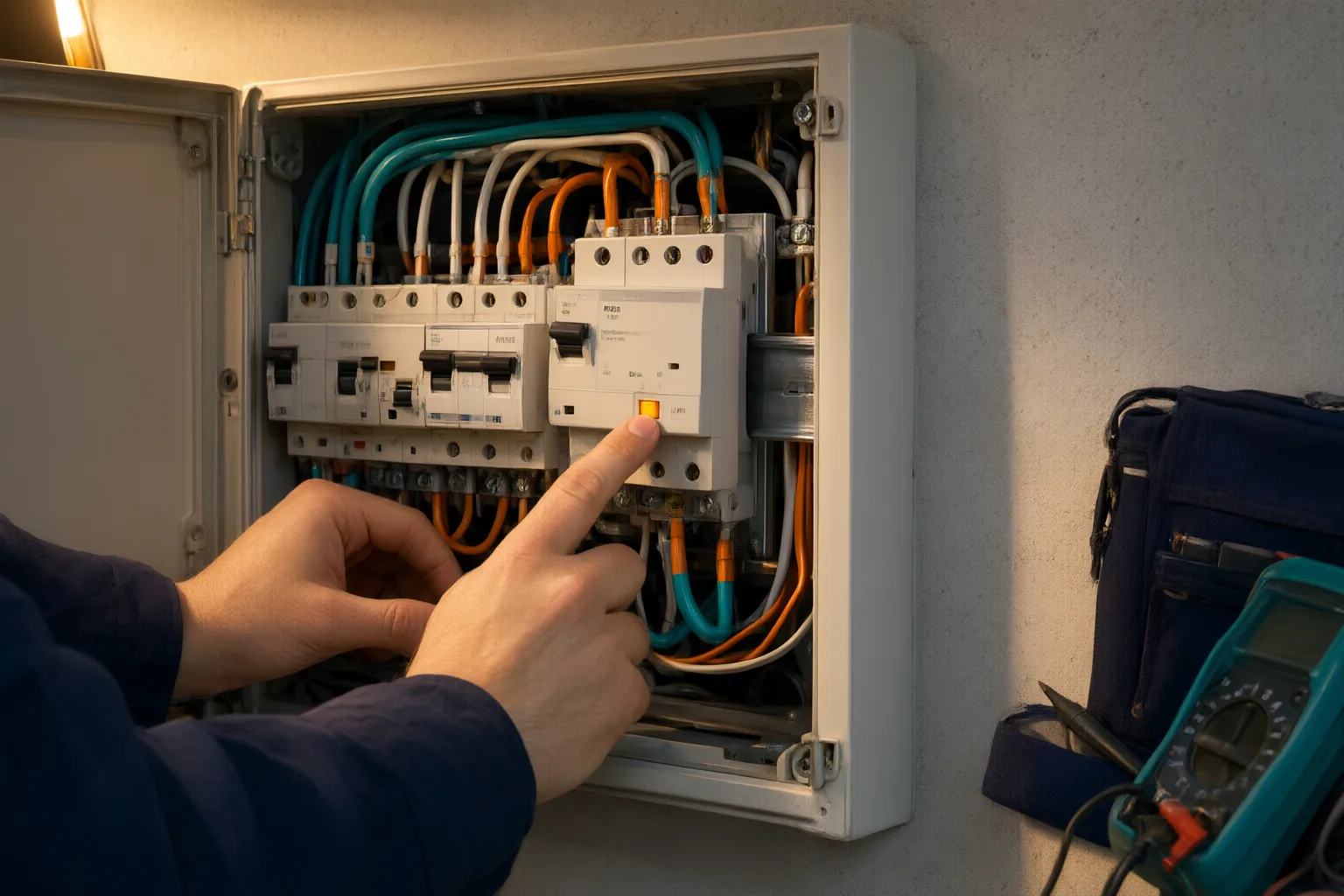
Take one concrete action this week: open your distribution board, note which protective devices you have, and press the test button on the earth-leakage unit — it simulates an earth fault by creating an imbalance. If the unit does not trip instantly, or you are unsure what a device protects against, contact a qualified electrician rather than resetting and ignoring the warning.
Disclosures and limitations
- AI assistance and sourcing: this explainer was drafted by an AI writer agent using only the research sources cited by ID in each section; no products were bought, tested or reviewed, and no personal experience is claimed.
- Evidence boundaries: the cited sources are generic electrical-engineering references; they do not cover surge protectors or SPDs, and they contain no Nigeria-specific wiring regulations, availability or pricing data. Comparative judgments, such as RCBO cost versus standalone devices, reflect the cited sources rather than independent tests. No affiliate relationships apply because no products are recommended.
Related reading
- Electricity Consumers in Nigeria
- How Nigerian Electricity Customers Should Respond to a Meter Bypass or Tampering Allegation
- How a New Tenant Can Verify and Resolve Electricity Debt Attached to a Nigerian Property
Sources
- Earth-leakage circuit breaker – Wikipedia — en.wikipedia.org
- Earth Leakage Protection: ELCB vs RCD vs RCBO – HSE STUDY GUIDE — HSE STUDY GUIDE
- Earth Fault Protection or Leakage Protection | Overload Protection — EEEGUIDE.COM
- Earth Leakage Protection: What It Is, How It Works, Devices | Electrical Testing London — Electrical Testing London
- ELCB (Earth Leakage Circuit Breaker) – Types and Working — ELECTRICAL TECHNOLOGY
- Ground Fault Protection | CBI Inc — CBI Inc North America