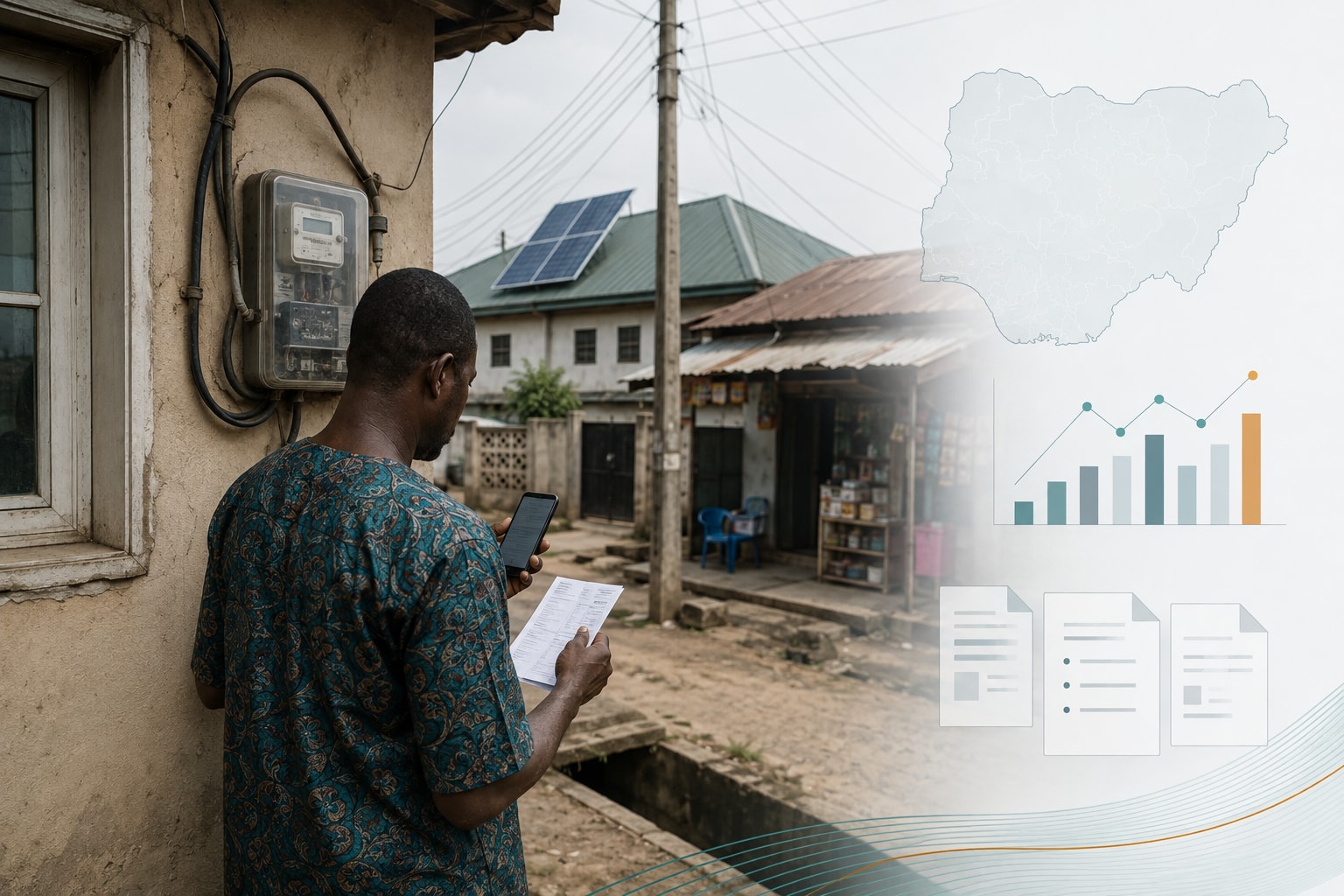
Available evidence links electricity complaints in Nigeria to unreliable service, affordability pressures, limited metering, weak complaint resolution and an evolving division of federal and state regulatory responsibility.
Why electricity consumer complaints matter in Nigeria
Electricity consumer complaints in Nigeria sit within a broader gap between formal regulation and everyday service outcomes. Consumers continue to face difficulty obtaining electricity that is stable, affordable and reliable. Some surveys cited in the available evidence recorded more than 32 outages per month, illustrating the frequency of disruption experienced in parts of the country.
Nigeria already has regulatory instruments covering areas such as tariffs, licensing, grid standards and consumer protection. Their existence, however, does not guarantee an effective remedy when a customer experiences poor service. The available evidence identifies inadequate complaint resolution and limited progress in metering as continuing constraints on consumer protection.
Complaints therefore matter for more than resolving individual disputes. They can reveal whether service standards, consumer safeguards and regulatory decisions are producing practical results. They also raise questions about which institution is responsible as electricity-market authority begins to shift from the federal level to emerging state systems.
The recurring problems reflected in the available evidence
The evidence points to several connected sources of consumer dissatisfaction. The first is unreliable supply. Frequent interruptions affect whether households and organizations can depend on electricity, while the broader record indicates that consumers still struggle to secure stable and affordable service.
Metering is another reported weakness. Insufficient progress in expanding access to meters limits the practical effect of consumer protections, particularly where a dispute depends on how electricity consumption or charges have been determined. The research package does not provide enough detail to quantify the current metering gap or describe rules for a particular customer, so those matters require current official verification.
Complaint resolution itself is also identified as inadequate. This is significant because protections on paper have limited value if problems cannot be reviewed and resolved effectively. The available material does not establish official submission channels, response deadlines or appeal stages, so it cannot support a universal step-by-step complaint procedure.
Transparency compounds these problems. Regulatory documents and decisions are reportedly not published consistently, weakening public accountability and making it harder to assess how rules are being applied. Together, unreliable service, incomplete metering, weak resolution mechanisms and inconsistent disclosure help explain why consumer complaints persist despite an established regulatory framework.
Who regulates electricity consumer protection
The Nigerian Electricity Regulatory Commission, commonly known as NERC, has an established role in electricity-industry regulation. A secondary institutional description identifies it as an independent regulator whose responsibilities include protecting consumer interests, licensing operators and investors, and setting and reviewing tariffs.
These responsibilities place consumer protection within a wider regulatory system. Decisions about operators, tariffs and industry rules can all affect the conditions under which consumer complaints arise and are assessed. NERC’s role is therefore not limited to individual disputes; it forms part of the broader oversight of electricity-sector conduct.
The institutional description used here comes from Wikipedia, which is editable and may become outdated. It is used only for the relatively stable description of NERC’s core responsibilities, not for leadership details or a current complaint procedure. Consumers and other readers should confirm present responsibilities through current information from the regulator, especially where a state electricity framework may now apply.
How state electricity-market reforms affect regulatory responsibility
The Electricity Act 2023 changed the institutional context by allowing Nigeria’s 36 states to provide for electricity generation, transmission and distribution within their jurisdictions. According to the available account, 10 states had enacted electricity-market laws and begun establishing state regulators and related frameworks by July 2025.
This creates a developing division of responsibility. In places where a state legal and regulatory framework has been established, the relevant state institution may have responsibilities that previously sat at the federal level. Where such state laws have not been established, the evidence says NERC continues to regulate the industry.
The transition may create uncertainty about coordination, regulatory clarity and the capacity of individual states to implement their new responsibilities. It also means that a general statement about Nigerian electricity regulation may not identify the correct authority for every location.
Before pursuing a current complaint process, a consumer should establish whether the relevant service falls under a functioning state electricity framework or remains within federal regulation. Because the available research captures an evolving situation rather than a complete state-by-state register, the applicable authority must be verified using current regulator or provider information.
What regulatory performance indicators suggest
The Conversation, citing the African Development Bank’s 2024 Electricity Regulatory Index, reported that Nigeria ranked 15th among 43 assessed countries. It also reported a regulatory governance score of 0.897, a regulatory substance score of 0.843, a regulatory outcome score of 0.642 and a quality-of-service score of 0.512.
The pattern is more informative than the overall ranking alone. The reported governance and substance scores are higher than the outcome and service-quality scores. That is consistent with the account’s broader conclusion that Nigeria has developed substantial regulatory rules and structures but has not achieved equally strong implementation and consumer-facing results.
These figures should be read with appropriate caution. The research package contains The Conversation’s account of the African Development Bank assessment, not the underlying report itself. The scores and ranking are therefore presented as indirectly reported indicators, not as independently checked primary-source data. They provide context for understanding the gap between regulatory design and consumer experience, but they do not resolve any individual complaint.
Why formal protections do not always produce effective remedies
Nigeria’s regulatory framework reportedly includes tariff methods, licensing arrangements, grid codes and consumer-protection rules. The central weakness identified in the available evidence is not simply an absence of formal instruments, but a gap between institutional design and forceful, consistent implementation.
Several reported limitations help explain that gap. Complaint resolution and metering have not progressed sufficiently, reducing the practical effect of consumer safeguards. Regulatory decisions and documents are not always published consistently, limiting transparency and the ability of consumers or observers to hold institutions accountable. Service outcomes also remain weak relative to the reported scores for governance and regulatory substance.
Decentralization adds another implementation challenge. State electricity markets may make regulation more responsive to local conditions, but the transition also creates potential uncertainty over coordination, the clarity of institutional roles and the capacity of different states to enforce their frameworks. Outcomes may consequently vary as state systems develop.
Formal rights and rules remain important, but effective consumer protection also depends on accessible resolution, transparent decisions, clear jurisdiction and capable enforcement. The available evidence indicates that these operational conditions have not yet matched the relative strength of Nigeria’s regulatory design.
What consumers can establish before pursuing a complaint
The research package does not contain an official, current complaint procedure, so it would be misleading to prescribe submission channels, deadlines or appeal levels. It does support two preliminary steps.
First, document the issue clearly. A useful record should distinguish the nature of the problem—such as interrupted service, metering or another service concern—and preserve the information needed to describe what occurred. This is preparation guidance, not a claim about a regulator’s formal evidence requirements.
Second, determine which regulatory framework applies. NERC has established federal responsibilities that include consumer protection, but the Electricity Act 2023 permits state electricity markets, and some states have begun creating their own laws and regulators. Responsibility may therefore depend on the consumer’s location and the current status of that state’s framework.
After establishing those points, the consumer should obtain the current procedure from the responsible regulator or electricity provider. This approach avoids relying on an outdated or unsupported national process while state and federal roles continue to evolve.
Evidence limitations and points requiring current verification
This explanation has several important limits. The sources provided do not include an official NERC or state-regulator complaint procedure. They do not establish current submission addresses, required forms, response periods or appeal stages. Those details must be checked with the institution currently responsible for the relevant location and service.
The reported regulatory ranking and scores come through The Conversation’s account of an African Development Bank assessment; the underlying report was not included. The description of NERC’s core duties comes partly from Wikipedia, an editable secondary source, and should not be used for potentially changing details such as leadership or current procedures.
State-level authority is also evolving. The evidence records the position as of July 2025 but does not provide a complete, continuously updated list of operational state regulators. Readers should therefore verify current jurisdiction before acting. The package also contains no search-volume or growth evidence, so it does not support a claim that this subject is currently trending.
Disclosures and limitations
- This article was prepared with AI assistance from the approved content plan and supplied research package; no independent browsing, product use, purchase, testing or interviews were conducted.
- Material claims are based on the two supplied sources. Regulatory scores and rankings are attributed to The Conversation’s account of the African Development Bank’s 2024 assessment, while the description of NERC’s core responsibilities partly relies on Wikipedia, an editable secondary source.
- The supplied material did not include official current complaint channels, deadlines or appeal procedures. Readers should verify those details and the applicable federal or state jurisdiction with the responsible regulator or electricity provider.
- This article contains no product recommendations or affiliate links.