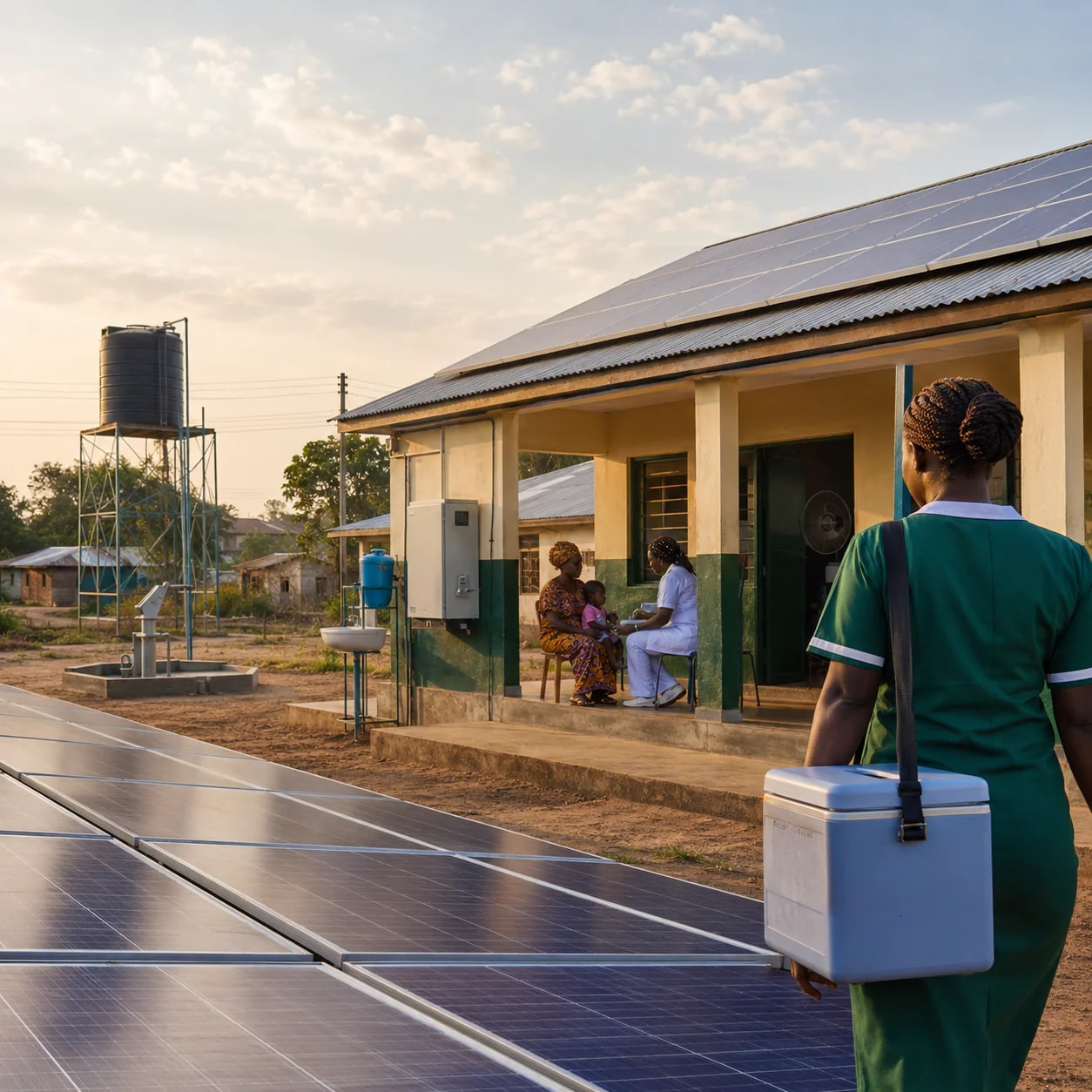
Reliable electricity may help Nigerian healthcare facilities sustain electricity-dependent services, but the available evidence does not establish that renewable projects have reduced hospital outages or improved health outcomes in the country.
Why electricity reliability is a public-health issue
Electricity reliability becomes a public-health concern when essential health services depend on powered equipment. ISS African Futures identifies unreliable electricity supply as a long-term structural constraint on Nigeria’s economic growth. Separately, an industry article from Acrel states that ventilators, cardiac monitors and anesthesia machines require electricity and argues that critical hospital areas need continuous power.
Taken together, these sources support a limited but important conclusion: interruptions in electricity supply can create operational risks wherever healthcare facilities rely on electricity-dependent equipment. They do not, however, quantify outages in Nigerian health facilities or demonstrate resulting effects on patient safety or health outcomes. The evidence establishes the relevance of reliable power to service continuity, not the scale of the consequences in Nigeria.
This distinction matters when considering renewable power and public health. The case begins with a documented national electricity-reliability problem and the general dependence of medical equipment on power. Any stronger claim—such as a measured reduction in deaths or treatment interruptions—would require facility-level evidence that is not present in the supplied research.
What healthcare facilities need electricity to support
The available equipment-focused source identifies three examples of electricity-dependent hospital technology: ventilators, cardiac monitors and anesthesia machines. It uses these examples to argue that uninterrupted power is necessary for critical medical equipment and key hospital areas.
That evidence helps explain why hospital power supply is not merely an administrative concern. If a facility provides services using such equipment, electricity continuity is part of its ability to keep those services operating. The source does not provide evidence about how frequently Nigerian facilities use each device, their power requirements, or the backup arrangements available at particular sites.
The source also has a significant limitation: it is a commercial industry blog published by Acrel, not Nigeria-specific clinical or public-health research. Its statements therefore provide general context about powered medical equipment, but they should not be treated as a measurement of Nigerian hospital conditions. Project assessments should verify actual equipment, demand and continuity requirements at each facility instead of assuming that a general hospital description applies uniformly.
Where weak access to power and healthcare may overlap
The European Union’s humanitarian-aid page reports that 5.9 million people in northeastern Nigeria need humanitarian assistance. It says supported activities include primary healthcare, emergency medical supplies and assistance for stabilization treatment centres. The same source reports that violence and access restrictions leave roughly 400,000 to 500,000 people difficult to reach with aid.
A separate Wikipedia compilation on Nigerian climate finance reports a national electricity-access rate of 61.2% in 2023, with 89% access in urban areas and less than 33% in rural areas. It also attributes about $29 billion in annual economic losses to frequent grid failures. Because these figures come from a secondary compilation, they require confirmation from current Nigerian government or other authoritative primary sources before use in policy or investment decisions.
The two sets of information suggest a possible overlap: populations already facing barriers to healthcare or humanitarian assistance may also live in places where electricity access is weaker. This is a reasonable inference, especially when considering the reported urban-rural access gap, but it is not a direct measurement of electricity conditions at healthcare facilities in northeastern Nigeria. The supplied sources do not map individual facilities, compare their outage rates or show that the people described in the humanitarian data are the same people represented by the rural electricity figures.
How decentralized renewable power could improve local supply resilience
The general case for decentralized renewable energy is that power produced closer to where it is used may reduce dependence on long-distance delivery. An EU renewable-energy directive adopted in 2009 stated that decentralized renewable production can use local energy sources, improve local energy-supply security, shorten transport distances and reduce transmission losses.
These principles offer a framework for considering local renewable supply in healthcare settings. A proposal could examine whether locally produced electricity would make facility supply more secure and reduce exposure to transmission constraints. Those possibilities are relevant to resilience, but the cited directive does not establish that they have been achieved in Nigerian health facilities.
The legal and geographic limits of the source are essential. The directive expired in 2021 and concerned the European Union; it is neither current Nigerian policy nor evidence of Nigerian implementation. It supports only a general explanation of potential decentralized-energy benefits. Whether a particular Nigerian project delivers those benefits must be demonstrated with local performance data rather than inferred from the directive.
Potential public-health pathways—and what remains unproven
The evidence supports a cautious pathway rather than a proven outcome. Nigeria has a documented electricity-reliability challenge. Certain critical medical devices depend on electricity. Decentralized renewable production may, as a general principle, strengthen local energy security and reduce transmission distances and losses. If a locally designed system actually improves a facility’s electricity continuity, it may help that facility maintain electricity-dependent services.
Each link in that pathway requires verification. The supplied sources do not show that decentralized renewable projects have reduced outages at Nigerian hospitals. They do not measure whether ventilators, cardiac monitors or anesthesia machines remained available for longer because of renewable supply. Nor do they establish effects on patient safety, treatment completion or population health.
This means “could support” is more accurate than “has improved.” The plausible public-health value lies in service continuity, but the research package does not quantify that value or confirm implementation success. Decision-makers should distinguish the general technical rationale from evidence about actual facilities. Claims of better health outcomes would need Nigerian data connecting a defined power intervention to measured changes in outages, service delivery and health results.
Questions decision-makers should ask before supporting a project
An evidence-oriented review should begin with the facility rather than assume that the general advantages of decentralized renewable energy will transfer automatically. Useful questions include:
– Which electricity-dependent services and devices must the facility keep operating, including any ventilators, cardiac monitors or anesthesia machines? – What level of continuity does each identified service require, and how will local performance be documented? – Is the facility located in an area affected by access restrictions or other barriers to delivering healthcare and humanitarian assistance? – How would those access conditions affect implementation, support and verification? – Will the proposed system demonstrably improve local energy security or reduce reliance on longer transmission routes? – What facility-level indicators will show whether electricity continuity actually improved? – What evidence will distinguish reliable performance from an assumed benefit of renewable technology?
These questions reflect the sources’ central limitations. The humanitarian evidence shows that some communities are difficult to reach, while the equipment source emphasizes continuity for powered medical devices. The expired EU directive describes general benefits of decentralized production. None of them proves that a specific project is appropriately designed or effective in a Nigerian healthcare setting. Support should therefore depend on verified local needs and performance evidence.
Evidence limitations and priorities for better data
The research base has three prominent limitations. First, the description of electricity-dependent hospital equipment comes from a commercial industry blog and contains no Nigeria-specific facility data. Second, the electricity-access rates and estimated economic losses come from a Wikipedia compilation rather than a primary statistical source. Third, the decentralized-energy rationale comes from a European directive that expired in 2021 and does not represent Nigerian policy or project performance.
Better evidence would include current primary data on electricity access in Nigerian healthcare facilities, the frequency and duration of facility outages, and the continuity of electricity-dependent services. Evaluations would also need to connect a clearly defined energy intervention with observed performance and health-service outcomes before making causal claims.
Until such evidence is available, national access figures should be checked against current authoritative sources, and project claims should be tested with local facility data. The present material can explain why the connection is plausible, but it cannot establish the size of the need in individual facilities or the results of renewable-energy deployment.
Conclusion: a plausible connection that requires local verification
Reliable electricity matters wherever healthcare services depend on powered equipment. Nigeria’s broader electricity-reliability constraint, the documented humanitarian needs in the northeast and the dependence of critical medical devices on electricity make the relationship between power and public health worthy of careful assessment.
Decentralized renewable generation offers a plausible route to stronger local energy security and shorter transmission distances. Yet the supplied evidence does not show that this potential has translated into fewer Nigerian hospital outages, safer care or improved health outcomes.
The responsible conclusion is therefore conditional: renewable power may support health-service resilience when it produces verified improvements in facility-level electricity continuity. Policymakers and investors should use the cited evidence as a starting point, acknowledge its limitations and seek current primary-source and local performance data before approving or promoting specific projects.
Disclosures and limitations
– This article was produced with AI assistance from the supplied Content Plan and Research Package and should receive editorial review before publication. – All material claims are attributed through the listed source IDs. The evidence includes an ISS African Futures source, an EU humanitarian-aid page, a commercial Acrel industry blog, a Wikipedia compilation and an expired 2009 EU directive; several claims require verification against current Nigerian or other authoritative primary sources. – The available research does not directly establish that renewable-energy projects have reduced Nigerian healthcare-facility outages or improved patient safety or health outcomes. – This article contains no product recommendations or disclosed affiliate links. If commercial recommendations or affiliate links are added later, that relationship and the associated risk of financial bias should be stated clearly.
Sources
– Nigeria — European Civil Protection and Humanitarian Aid Operations – How Distributed Energy Resources Improve Energy Access — linkedin.com – Economy of Zambia – Wikipedia — en.wikipedia.org – Powering Patient Care: the Importance of Hospital Isolated Power Systems – Acrel Co., Ltd. — Acrel Co., Ltd. – Confronting the Solar Manufacturing Industry’s Human Rights Problem — The Breakthrough Institute – Nigeria Development Futures – ISS African Futures — futures.issafrica.org – Environmental issues in the Niger Delta – Wikipedia — en.wikipedia.org – Climate finance in Nigeria – Wikipedia — en.wikipedia.org – Directive – 2009/28 – EN – Renewable Energy Directive – EUR-Lex — eur-lex.europa.eu