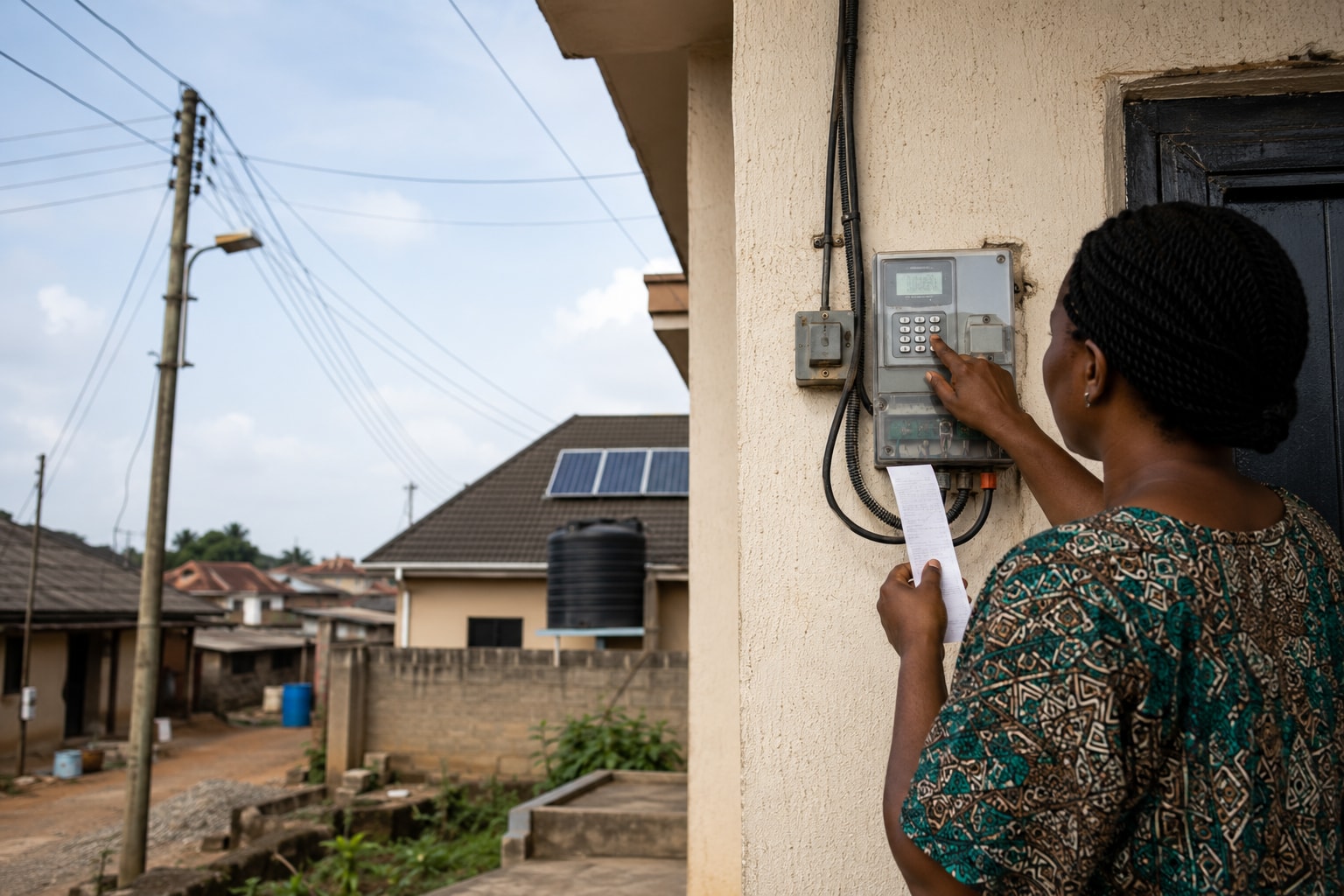
Nigeria’s tariff bands connect electricity charges to expected supply hours. This guide explains how classification, rate changes, deductions, metering and actual service can affect prepaid units and bills.
Nigeria Electricity Tariff at a Glance
Nigeria’s electricity tariff system places customers in Bands A to E according to the daily electricity supply associated with their local distribution feeder. This classification matters because a customer’s band can affect the applicable per-kilowatt-hour rate, the number of units received from a prepaid recharge and the service level the customer should expect.
Consumers therefore need to know their assigned band before comparing recharge units or questioning a bill. When the same payment buys fewer units than before, possible explanations include a different tariff classification, a rate adjustment, arrears or another deduction. Customers who do not know their band can use their meter or account number to request confirmation from their distribution company.
How Nigeria’s A-to-E Tariff Bands Work
According to The Conversation, the Nigerian Electricity Regulatory Commission classifies customers into five service bands based on the daily supply delivered through their local distribution feeder. Band A is associated with at least 20 hours of electricity a day, while Band E is associated with four to seven hours a day.
The classification is linked to the feeder’s service level rather than simply to how much electricity an individual household wants to consume. Customers on the same feeder may therefore share a tariff classification even when their personal consumption patterns differ.
This connection between service and price is central to understanding a bill. A customer should consider both the tariff applied and whether the feeder delivers the supply hours associated with that category. The research package does not provide the complete hour thresholds for Bands B, C and D, so customers in those bands should obtain the applicable classification and service commitment from their distribution company or the relevant regulatory documents.
What Changed for Band A Customers in 2024
The Conversation reported that an April 2024 adjustment primarily affected Band A customers, with the cited tariff increasing from ₦67 per kilowatt-hour to ₦225 per kilowatt-hour. These figures describe the reported 2024 adjustment; they should not be treated as confirmation of the rate currently applicable to every customer.
A higher per-kilowatt-hour charge means that the same prepaid payment will generally purchase fewer electricity units before any other deductions are considered. For postpaid customers, the rate also changes the cost assigned to measured consumption.
The adjustment sharpened two related consumer questions: whether a customer was correctly classified as Band A and whether actual supply met the reported Band A standard of at least 20 hours a day. Current billing decisions should be checked against the relevant NERC tariff order and the customer’s distribution-company records.
Why the Same Recharge Amount Can Buy Fewer Units
A fixed recharge amount does not always produce a fixed number of prepaid units. Commercial consumer guidance included in the research package identifies tariff band, rate changes, arrears and other fixed deductions as possible reasons for differences.
The tariff rate determines how much energy the available balance can purchase. If the applicable rate rises, fewer kilowatt-hours can be credited for the same amount. If arrears or another listed charge is deducted first, only the remaining balance is converted into electricity units.
Consumers should compare the amount paid, every deduction shown on the transaction record, the rate applied and the final units credited. This commercial guidance is useful as a troubleshooting framework, but it is not official evidence of a customer’s tariff. The applicable rate and classification should be confirmed with the distribution company and relevant regulatory records.
How to Confirm Your Tariff Band
If your tariff band is unclear, use your meter number or electricity account number to ask your distribution company for the classification attached to your service. The commercial guidance in the research package indicates that consumers cannot freely change their own tariff category.
When requesting clarification, ask the company to identify the recorded band and explain the rate used for the latest bill or prepaid purchase. Keep the receipt or token record so the payment, deductions and credited units can be compared with the company’s explanation.
Band confirmation is especially important after an unexpected change in units or charges. It helps separate a tariff issue from deductions or other account-specific adjustments.
Supply Hours: What Band A Customers Should Check
The Conversation associates Band A with at least 20 hours of electricity supply per day. Customers charged on that basis can compare the stated service category with the electricity availability they actually observe.
A useful review should distinguish sustained supply patterns from a single interruption. Record the dates and approximate periods when electricity is available or unavailable, then compare that record with the Band A service level. If the observed pattern appears inconsistent with the classification, request an explanation from the distribution company using the meter or account number.
This check matters because Band A combines a higher reported tariff with a higher expected level of supply. Confirming both sides—the rate charged and the service delivered—provides a clearer basis for raising a billing or classification concern.
Meters, Estimated Billing and Consumer Disputes
A meter links a bill more directly to measured electricity consumption. Without one, customers may be billed through estimates rather than a precise record of their individual use, making charges harder to verify and more likely to generate disputes.
The Conversation cited December 2024 data showing that 6.29 million of 13.5 million registered customers across 12 distribution companies had meters, equivalent to a metering rate of 46.57%. On those figures, more than half of registered customers were not metered at that point.
A customer reviewing an estimated bill should identify the billing method and ask the distribution company to explain how the amount was calculated. Metered customers should compare the units purchased or consumption recorded with the rate and deductions on their transaction documents. The cited metering figures are historical and sourced through secondary reporting, so they should be checked against official records before being presented as current statistics.
How Sector Losses Influence the Tariff Debate
Under the multi-year tariff-order framework described by The Conversation, NERC determines tariffs using the electricity industry’s total revenue requirement and the volume of energy actually billed and collected. This means tariff debates extend beyond the nominal price of electricity to the efficiency of delivering, billing and collecting payment for energy.
The same source reported aggregate technical, commercial and collection losses of 36.36% for distribution companies in the first quarter of 2024, rising to 39.10% in the third quarter. It also cited a technical and commercial loss rate of 39.6% for the first quarter of 2025, compared with a framework target of 20.5%.
These attributed figures help explain why sector efficiency, affordability and revenue requirements are discussed together. They should not be interpreted as losses caused by any individual customer. NERC describes its broader objective as creating an investment-supportive regulatory framework and efficient market structure capable of meeting Nigeria’s need for secure, adequate, reliable and affordable electricity.
Where Renewable Energy and Net Billing Fit In
BBC News Pidgin reported that Nigeria’s 2026 net-billing regulations create a pathway for eligible renewable-energy generators to send surplus electricity to a distribution company and receive credits on their electricity bills.
Participation is not automatic. According to the report, a participant must be connected to a distribution company’s network, obtain the company’s approval, sign a net-billing agreement and register with NERC.
Net billing is separate from the basic tariff-band explanation: it concerns eligible customers who generate renewable electricity and export a surplus, rather than changing a customer’s assigned service band. The source contains conflicting capacity-limit figures, so no capacity threshold is stated here.
A Consumer Checklist for Reviewing Your Electricity Charges
Use this checklist when a bill or prepaid recharge appears inconsistent:
- Confirm the tariff band attached to your meter or account number with your distribution company.
- Ask which per-kilowatt-hour rate was applied to the transaction.
- Compare the amount paid with the number of electricity units credited.
- Review the receipt for arrears or other deductions taken before units were calculated.
- Confirm whether the account is metered or billed through an estimate.
- If charged as Band A, compare actual availability with the reported standard of at least 20 supply hours per day.
- Keep bills, token records and a dated supply log when requesting clarification.
These checks do not determine the correct tariff by themselves, but they organize the information needed to ask the distribution company about unexplained charges, unit differences or service levels.
Evidence Limits and Verification Notes
Several rates, metering figures and loss statistics in this explanation come from secondary reporting rather than the underlying NERC tariff orders or quarterly reports supplied directly in the research package. They are attributed accordingly and should be checked against the applicable official documents before publication or use in an individual billing decision.
The practical guidance about confirming tariff bands and investigating recharge differences comes from a commercial service provider, not an official tariff source. Customers should treat it as a starting point and verify account-specific information with their distribution company.
Rates and classifications may depend on the applicable order and customer record. Use a meter or account number to confirm the band, rate and deductions relevant to a particular bill.
Disclosures and limitations
- This article was prepared with AI assistance using only the supplied research package and approved content plan.
- Material claims are attributed to the supplied sources. Several tariff, metering and loss figures come from secondary reporting and should be verified against applicable NERC orders, official reports and distribution-company records.
- The article contains no product recommendations or disclosed affiliate links. No personal product use, testing, purchase or interview experience is claimed.
Sources
- Nigerian Electricity Regulatory Commission – Wikipedia — en.wikipedia.org
- Selling electricity in Nigeria: How Nigerians fit sell electricity to national grid – who dey qualify? – BBC News Pidgin — BBC News Pidgin
- Nigeria raised electricity prices to improve supply. Why it hasn’t worked — The Conversation
- Nigeria – Import Tariffs — International Trade Administration | Trade.gov
- Five Electricity Policy Priorities for Nigeria – Energy for Growth Hub — Energy for Growth Hub
- Nigerian Electricity Regulatory Commission (NERC) — YouTube
- Port Tariffs — Nigerian Ports Authority
- Matters Pertaining To Nigeria's New Electricity Pricing — VIZTADAILY
- NIGERIAN ELECTRICITY REGULATORY COMMISSION — nerc.gov.ng
- Electricity Tariff Bands in Nigeria Explained (Band A–E & How to Get More Units) — VTUBOX