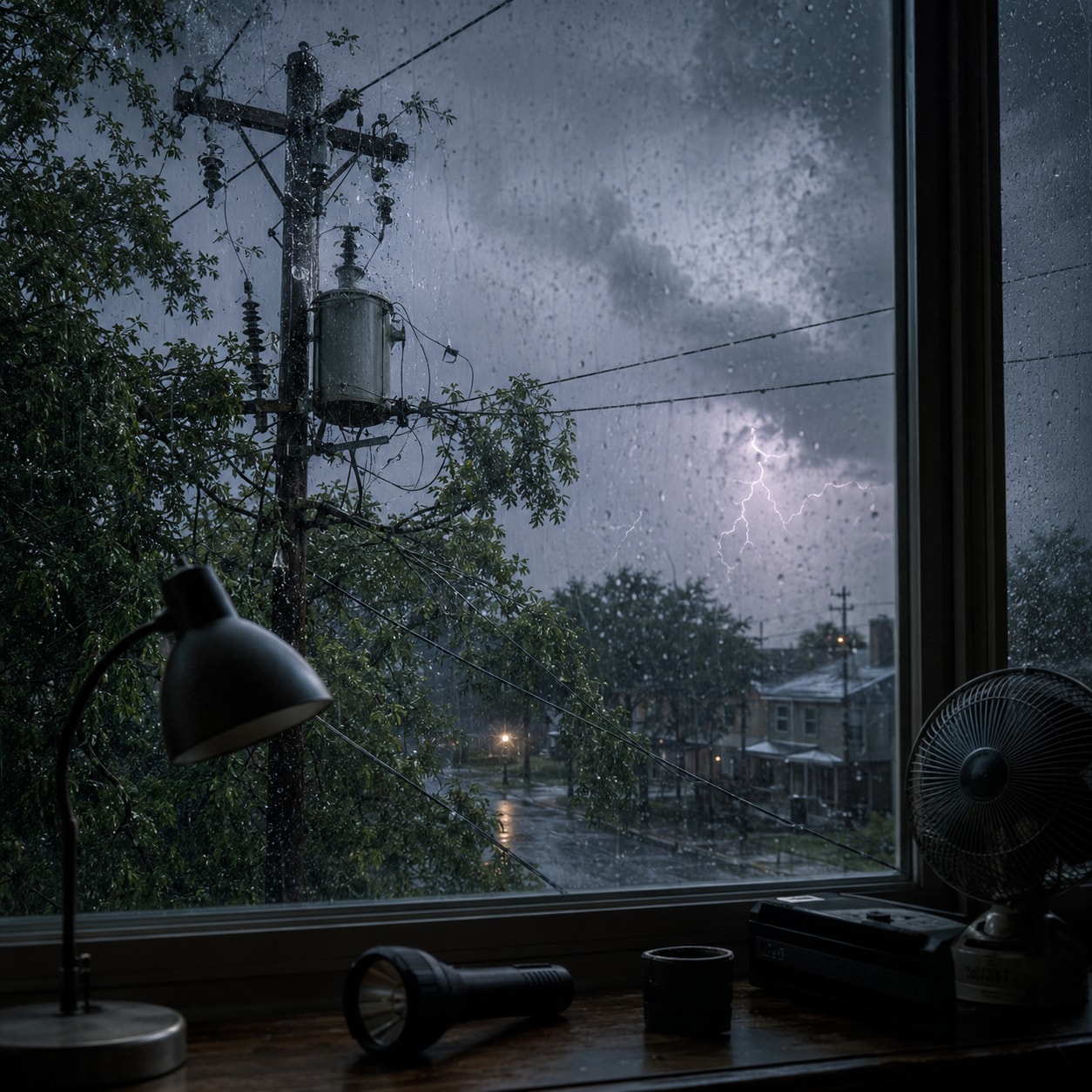
Rainy weather can coincide with electricity interruptions for several reasons, but timing alone does not establish the cause. The available evidence supports three general mechanisms while leaving any specific Nigerian outage unconfirmed.
Why rainy weather and an outage can occur together without proving causation
When electricity fails during rainfall, it may be tempting to conclude that the weather caused the interruption. The timing, however, is not enough to establish causation. SaskPower identifies summer storms, trees, flooding, underground cable faults and the condition of electrical infrastructure among factors associated with unplanned outages. That evidence supports several possible explanations, but it does not diagnose a particular incident in Nigeria.
The wider reliability context also matters. A supplied overview of Nigeria’s economy reports frequent power-supply difficulties, while atmosfair describes the national grid as outdated and overloaded and associates those conditions with frequent outages. These sources indicate that an interruption occurring during rain could have weather-related or pre-existing system factors—or a combination—but they do not show which factor caused a specific failure.
Until the responsible electricity provider issues an incident explanation, the cause should therefore be treated as unconfirmed.
Reason 1: Storms and lightning can damage transmission or distribution equipment
Storm conditions are one recognized contributor to unplanned electricity outages. Lightning can also precede failures affecting power lines or other equipment, although the available evidence does not show that this happens in every storm or that it caused a particular Nigerian interruption.
A historical New York City event offers an illustrative, non-Nigerian example. The supplied account says a transmission failure followed a lightning strike and that a second lightning strike caused the loss of two more overhead power lines. This demonstrates a documented pathway through which lightning and electricity-system failures can be connected.
That example should not be generalized into a diagnosis for Nigeria. It concerns a different place, system and incident. The evidence supports storm or lightning damage as one possible reason an outage may coincide with rainy weather, but confirming that explanation in an individual case would require information from the relevant provider or another authoritative incident report.
Reason 2: Trees and flooding can interfere with electricity infrastructure
Trees and flooding are also among the factors SaskPower associates with unplanned outages. Their inclusion shows that rainy or stormy conditions can coincide with environmental interference affecting an electricity network.
The supplied research does not establish how often trees or floods cause outages, how the mechanisms operate in every case or how significant they are within Nigeria. It also does not support assuming that flooding is involved merely because rain is heavy, or that trees are responsible whenever wind and rain precede an interruption.
These factors are therefore best understood as recognized possibilities rather than universal explanations. For a particular rainy-day outage, evidence of local flooding, tree interference or related network damage would need to come from the electricity provider or another incident-specific source. Without that evidence, the relationship remains plausible but unconfirmed.
Reason 3: Existing infrastructure weaknesses can make interruptions more likely
An outage during rain may also occur against a background of infrastructure problems that are not themselves caused by the weather. SaskPower lists the condition of electrical infrastructure among factors associated with unplanned outages and separately identifies underground cable faults.
For Nigeria, the supplied sources describe a broader reliability challenge. An overview of the country’s economy reports frequent power-supply difficulties. Atmosfair characterizes the national grid as outdated and overloaded and says these conditions lead to frequent outages. These are attributed descriptions rather than findings from a Nigerian grid operator or regulator, so they should be read with that limitation in mind.
Placed together, the evidence supports a cautious conclusion: the state of electricity infrastructure can be relevant when interruptions occur, including during rainy periods. It does not prove that rain created an underlying weakness, that rainfall triggered a specific fault or that infrastructure condition was the decisive factor in any individual Nigerian outage. Rain and an interruption may occur at the same time while the immediate cause lies elsewhere in an already constrained system.
Why outages matter for Nigerian households and businesses
Power interruptions can extend beyond the temporary loss of lighting. Ready.gov says outages can disrupt communications, water, transportation, retail services and banking access. They can also affect medical-device use and contribute to food spoilage or water contamination. SaskPower notes that interruptions affect electricity-dependent activities such as television and internet access.
Nigeria’s reliability context can intensify the practical and financial consequences. Atmosfair says frequent outages lead many residents and businesses to use diesel generators, creating a financial burden. This does not quantify the burden or establish that every household or business uses a generator, but it identifies an added cost associated with unreliable supply.
The consequences make accurate explanations important. Knowing whether an interruption arose from local storm damage, flooding, infrastructure condition or another cause can affect expectations about restoration, but the supplied sources do not provide that diagnosis for any specific Nigerian incident.
What to do safely during a rainy-day outage
Generator safety is especially important when rain or flooding is present. Ready.gov advises keeping generators dry and protected from rain or flooding because touching a wet generator or equipment connected to it can cause electric shock. A generator that has become wet should not be treated as safe to touch merely because the power is out.
Ready.gov also advises disconnecting appliances and electronics during an outage. Electricity may return with momentary surges or spikes that can damage connected equipment.
These precautions address two hazards supported by the available evidence: electrical shock involving wet generator equipment and damage to appliances when supply returns. They do not identify the cause of the outage. Consumers should keep the incident’s cause unconfirmed until the relevant electricity provider supplies an explanation, while following established electrical and generator safety guidance throughout the interruption.
What the available evidence cannot tell you about a specific outage
The available sources support three broad explanations for outages that coincide with rainy weather: storm or lightning damage, interference involving trees or flooding, and existing infrastructure weaknesses. They do not directly document three rain-related mechanisms in Nigeria or establish the cause of a particular Nigerian outage.
The sources also do not prove that every interruption during rainfall was caused by the weather. Nigeria’s reported power-supply difficulties and attributed descriptions of an outdated, overloaded grid provide important context, but they are not incident reports.
The most defensible conclusion is therefore limited: rainy weather can coincide with recognized outage factors, yet coincidence does not confirm causation. Treat any specific explanation as unverified until the responsible electricity provider publishes supporting information.
Disclosures and limitations
– This article was prepared with AI assistance from the supplied research package and approved content plan; its factual claims are limited to the listed source IDs. – The Nigeria reliability context includes an economy overview and a project-promoter source rather than an incident report from a Nigerian grid operator or regulator. General outage mechanisms must not be treated as proof of the cause of a specific Nigerian interruption. – No products are recommended in this article, and no affiliate relationship or purchase incentive informed its content.
Sources
– Economy of Nigeria – Wikipedia — en.wikipedia.org – Policies & action — climateactiontracker.org – Nigeria: Clean energy for rural electrification – atmosfair — atmosfair – Power Outages — ready.gov – Integrated Power and Utility Services – TRC Companies — TRC Companies – Managing Power Grid Reliability in Multiple Regions — linkedin.com – Policy Papers – ECPS — ECPS – Solar and Net Metering – JPUD — JPUD – The Causes of Power Outages — saskpower.com – List of major power outages – Wikipedia — en.wikipedia.org