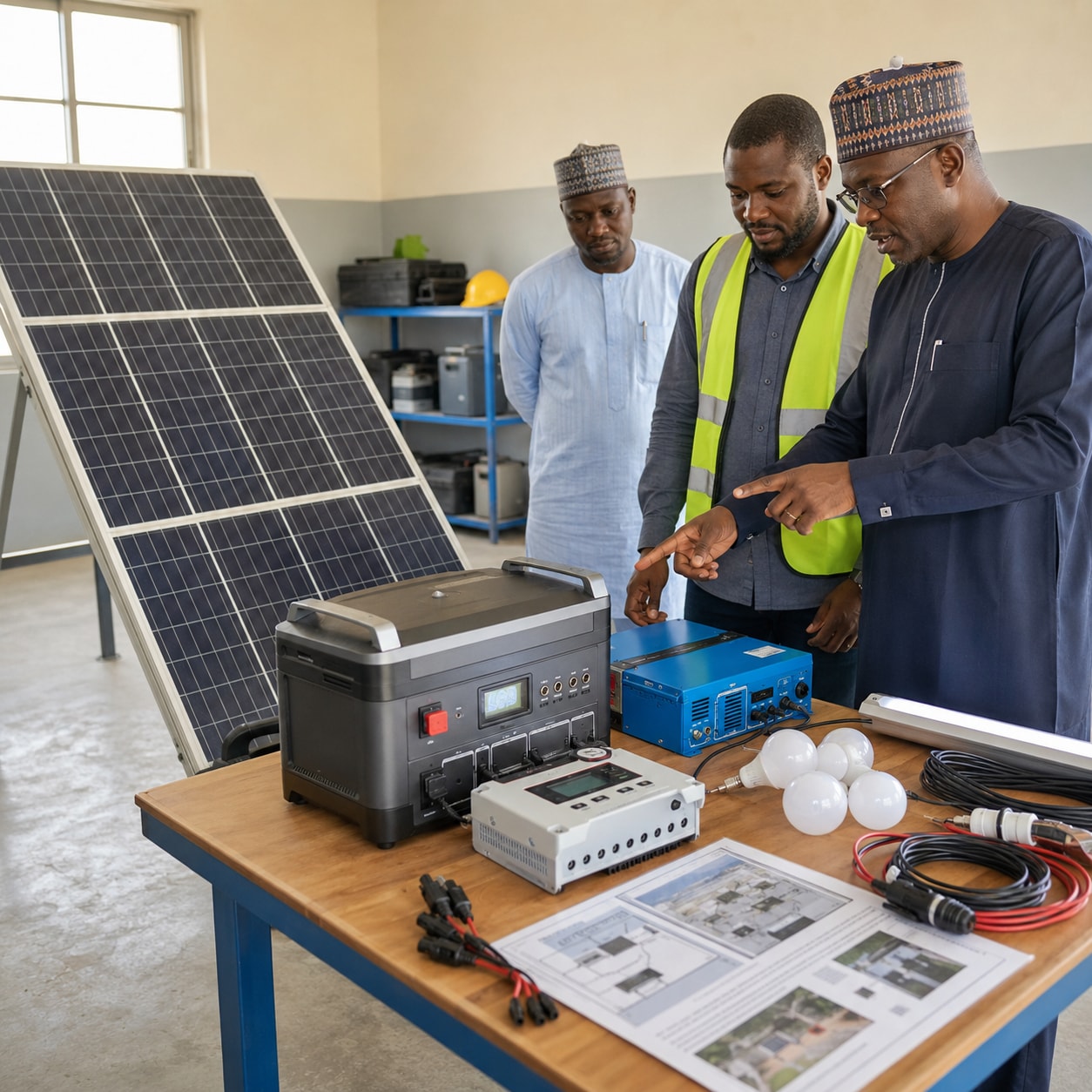
The supplied sources do not confirm a Federal Government engagement with Omatek, but they do provide evidence-backed context on distributed renewable energy and Nigeria’s reported 2026 net billing framework.
What is known about the reported Federal Government–Omatek engagement
The claimed engagement between Nigeria’s Federal Government and Omatek cannot be verified from the available research. Neither BBC News Pidgin’s report on the 2026 net billing regulations nor the Global Energy Alliance for People and Planet’s account of its distributed renewable-energy work mentions Omatek or confirms such an engagement.
Consequently, the participants, date, location and purpose of any discussions remain unconfirmed. The supplied evidence also does not establish a project site, generation capacity, financing arrangement, technology plan, regulatory approvals or implementation status. The headline claim should therefore be treated as unverified rather than reported as an established event.
The available sources are still useful for understanding the environment in which an off-grid solar proposal could be discussed. They describe distributed-energy initiatives and a regulatory framework for certain grid-connected renewable-energy generators, but that broader context is not proof of an Omatek agreement or project.
Why off-grid solar matters in Nigeria’s power sector
Distributed renewable energy connects several parts of Nigeria’s electricity-development agenda: access to power, business activity, project financing and the productive use of electricity. According to the Global Energy Alliance for People and Planet, its work in Nigeria includes support for the Energy Transition Office and measures intended to strengthen the distributed renewable-energy ecosystem.
The alliance says these measures include aggregating the purchasing requirements of small developers, designing a local-currency financing platform and supporting finance for productive-use appliances. These activities illustrate why solar-sector development involves more than installing generation equipment. Developers also need workable procurement arrangements and finance, while customers and businesses need equipment that can convert electricity access into useful economic activity.
These are institutional claims about the alliance’s own activities, not an independent assessment of their results. They nevertheless provide source-backed context for the financing, procurement and demand-side issues surrounding Nigeria’s distributed-energy market. They do not establish that the Federal Government has selected Omatek, agreed to finance an Omatek project or approved any particular off-grid installation.
How Nigeria’s 2026 net billing framework changes the solar context
BBC News Pidgin reports that the Nigerian Electricity Regulatory Commission introduced the 2026 Net Billing Regulations. Under the reported framework, eligible renewable-energy generators can export surplus electricity to a distribution company and receive credits on their electricity bills.
The report lists several conditions for participation. An applicant must be connected to a distribution company’s network and have a renewable-energy system with a capacity of at least 50 kWp. The applicant must also obtain the distribution company’s approval, enter into a net billing agreement and register with the regulator.
Approved participants are to use bidirectional meters. These meters record electricity drawn from the distribution network separately from electricity exported to it, providing the measurements needed to calculate net billing credits.
Net billing and off-grid power should not be treated as interchangeable concepts. The reported net billing rules concern eligible systems connected to a distribution network, whereas an off-grid installation operates outside that network. Even so, the framework changes the wider commercial and regulatory setting for distributed solar by creating a reported route through which qualifying connected generators can receive value for surplus output.
The supplied BBC material contains conflicting figures for the framework’s upper capacity limit, so no maximum is stated here. The reported eligibility requirements and credit mechanism also do not verify any relationship between the Federal Government and Omatek.
Who may struggle to participate
The reported 50 kWp minimum could place net billing beyond the reach of many smaller electricity users. BBC News Pidgin cites a solar-industry participant who argues that this threshold exceeds the generation scale of many ordinary homes and small businesses. That concern suggests the framework may be more immediately accessible to larger systems, although the supplied evidence does not quantify how many potential participants would be excluded.
Capacity is only one possible barrier. The Global Energy Alliance for People and Planet describes developer sustainability, financing, procurement and growth in electricity demand as interconnected needs within Nigeria’s distributed renewable-energy ecosystem. A project can therefore face constraints even when suitable solar resources and customer interest exist: developers need access to equipment and workable finance, while productive demand can influence whether new electricity supply supports durable economic activity.
These points do not demonstrate that every household, business or developer faces the same obstacles. They show that regulatory eligibility, project finance, procurement capacity and demand development must be considered together when assessing who can participate in distributed solar and on what terms.
A community microgrid example—and its verification limits
A company statement offers one example of the scale at which a Nigerian community microgrid may be expanded. On its LinkedIn page, Renewvia Energy says an expansion of the Ozuzu community microgrid would increase solar photovoltaic capacity from 28.08 kWp to 62.64 kWp. It also says battery storage would rise from 44.4 kWh to 88.8 kWh.
Those figures should be read strictly as Renewvia’s account. The supplied research does not include an independent source confirming the equipment capacities, completion of the expansion or its operating performance. The example may help illustrate the size and storage components of a stated community project, but it cannot substantiate claims about Omatek or establish wider sector outcomes.
What evidence is still needed
Confirming the Omatek claim requires primary documentation from the Federal Government, NERC or Omatek. A reliable record would need to identify who participated, when an engagement occurred and whether it involved an exploratory discussion, a formal agreement or an approved project.
Any associated project claim would also require documentation covering its location, planned capacity, funding source, technology, regulatory approvals, delivery schedule and current implementation status. Until such records are available, those details should not be inferred from Nigeria’s broader solar policies or from unrelated distributed-energy projects.
A LinkedIn post connected with a Nigerian energy summit identifies high project costs, dependence on fuel imports, inadequate gas infrastructure and gaps in local-content implementation as stakeholder concerns. These are attributed views from a social-media post, not conclusions confirmed by an official document in the research package. They therefore cannot fill the evidence gap surrounding Omatek.
Readers should consult subsequent statements from the Federal Government, NERC or Omatek before treating the reported engagement or any associated project details as confirmed.
Disclosures and limitations
– This article was prepared with AI assistance and reviewed against the supplied Research Package and approved Content Plan. – The article relies only on the supplied BBC News Pidgin, Global Energy Alliance for People and Planet, Renewvia Energy LinkedIn and energy-summit LinkedIn materials. Institutional and social-media claims are attributed to their publishers and are not presented as independently verified findings. – No products are recommended, and no affiliate relationship is asserted. Any future commercial links or affiliate arrangements should be disclosed clearly before publication.
Sources
– EnergySage | LinkedIn — linkedin.com – – YouTube — youtube.com – Funtua – Wikipedia — en.wikipedia.org – Nigeria | Where we work | Global Energy Alliance for People and Planet — Global Energy Alliance for People and Planet – Swiss Zurich Bank grows with high-risk clients and collapses after suspicion of money laundering for Iran, Russia, and Venezuela; the U.S. cuts access to the dollar and forces liquidation on 02/27/2026 total. — CPG Click Oil and Gas – Selling electricity in Nigeria: How Nigerians fit sell electricity to national grid – who dey qualify? – BBC News Pidgin — BBC News Pidgin – Legal framework — The independent public prosecution office of the EU – Nigeria Energy Summit Abuja Discusses Sector Challenges | Oluwabukola Akande posted on the topic | LinkedIn — LinkedIn – Renewvia Energy | LinkedIn — linkedin.com – Economy of Zambia – Wikipedia — en.wikipedia.org