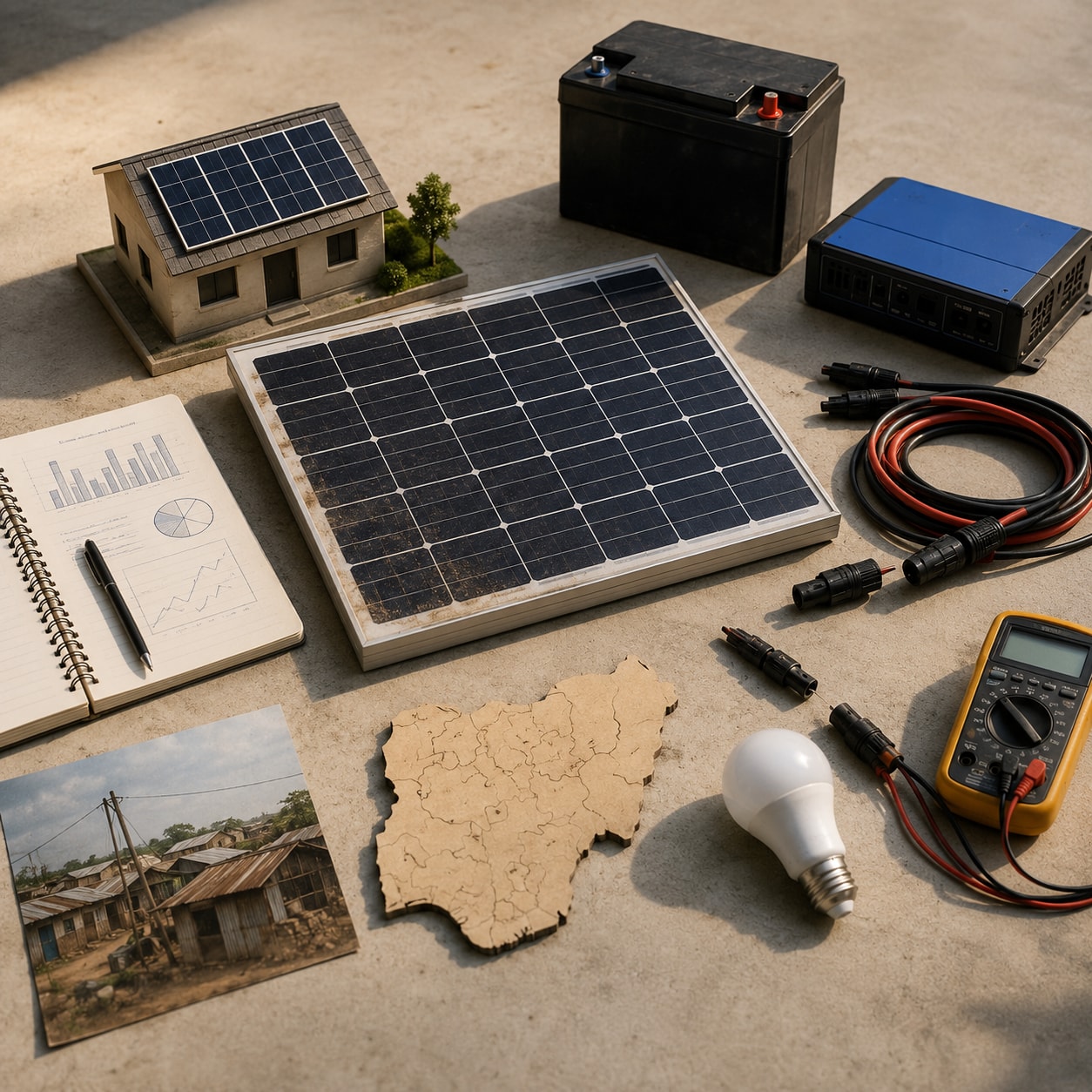
Nigeria’s unreliable electricity supply, generator dependence, solar-panel imports, mini-grid activity and financing programs point to significant solar PV use cases—but foreign-exchange pressure, import costs, grid risks and limited primary data complicate the outlook.
Nigeria’s solar PV opportunity in context
Nigeria’s solar PV opportunity is best understood as a response to electricity-access and reliability problems, not as an unqualified growth story. Mordor Intelligence estimates that the country’s total renewable-energy capacity will rise from 3.59 GW in 2025 to 4.51 GW in 2026 and forecasts 14.07 GW by 2031. These proprietary figures cover the broader renewable-energy market; they are not measured solar PV capacity or verified solar-market forecasts.
That distinction matters because hydropower accounted for an estimated 86.90% of Nigeria’s renewable-energy market in 2025, according to the same source. Broader renewable totals therefore cannot be used as a proxy for the size of the Nigeria solar PV market. The available evidence instead supports a more focused assessment of distributed systems, imported equipment, mini-grids, financing mechanisms and policy conditions.
Why unreliable electricity supply is driving distributed solar demand
Unreliable grid supply and recurring outages create practical demand for electricity generated close to where it is consumed. For households and businesses, distributed solar can address a need for more dependable power without relying exclusively on the grid.
The alternative is often diesel or petrol generation. The supplied sources identify high fuel costs and local pollution as burdens associated with these generators. These pressures help explain the use case for household, commercial and other distributed solar installations: users are looking for ways to reduce their exposure to outages and recurring generator fuel expenses.
This does not mean that every solar installation will be economical or capable of replacing a generator. The research package provides no product prices, system designs or customer-level cost comparisons. It does, however, document the underlying problem that distributed generation is intended to address. Opportunity therefore depends on matching solar systems and financing arrangements to actual electricity needs, affordability and local supply conditions.
What import activity indicates—and what it does not prove
iDNES, citing Bloomberg, reported that Nigeria imported solar panels representing 1,721 MW of capacity over the preceding year, making it Africa’s second-largest PV importer after South Africa. The figure indicates substantial equipment movement and provides evidence of active demand within the solar supply chain.
It should nevertheless be interpreted cautiously. The underlying Bloomberg report was not included in the supplied research, so the figure is indirectly sourced. Imported panel capacity is also not the same as commissioned generating capacity: the evidence does not show when every module was installed, whether all imported equipment remained in Nigeria or how much electricity the equipment ultimately produced.
Import activity alone consequently does not establish the installed size, revenue or future growth rate of Nigeria’s solar PV market. It is one market-activity indicator that should be evaluated alongside verified installation, commissioning and operational data.
Mini-grids and rural electricity access
Solar mini-grids offer a development pathway for communities where conventional electricity infrastructure is limited. They can serve localized demand while avoiding dependence on immediate expansion of the wider network. Evidence of operating activity is already present: iDNES reported that Husk Power Systems operated 70 solar mini-grid systems in Nigeria at the time of publication.
International financing is another part of this pathway. iDNES reported that a US$750 million World Bank investment was supporting electricity-access and infrastructure changes in Nigeria, including in remote areas. Mordor Intelligence separately identifies performance-based grants under the US$750 million DARES program as a mechanism for closing mini-grid projects’ upfront capital gaps.
Upfront support is important because rural mini-grids must reconcile construction costs with customers’ ability to pay for basic electricity. Capital grants can improve project feasibility, but the supplied evidence does not establish that every supported project will remain affordable or financially sustainable. Assessments should examine current grant terms, customer demand, operating costs and payment performance using primary program and project documents.
Financing and policy conditions shaping development
Policy decentralization may create more localized routes for electricity-market development. Mordor Intelligence states that Nigeria’s 2023 Electricity Act decentralized market oversight and enabled states to define feed-in tariffs. For solar developers, state-level frameworks could influence project approval, revenue arrangements and investment decisions.
Financing support can also address the high initial cost of development. Mordor Intelligence reports that performance-based grants under DARES are intended to help close upfront capital gaps for mini-grid projects. Such support may make projects more feasible where commercial capital alone cannot accommodate development costs and consumer affordability constraints.
These points are based on a commercial market-research summary rather than the underlying Nigerian regulatory and program documents. They should not be treated as a complete description of state powers, tariff rules, eligibility requirements or grant conditions. Developers and investors should verify decisions against the current Electricity Act framework, applicable state regulations and primary DARES documentation.
Foreign exchange, import costs and grid-related constraints
Solar development remains exposed to economic and infrastructure constraints. Mordor Intelligence identifies foreign-exchange shortages, equipment import duties and elevated equipment costs as obstacles for renewable-energy projects in Nigeria. Because imported equipment requires access to foreign currency, shortages or adverse cost movements can weaken project economics and delay procurement or construction.
Grid-connected projects face an additional set of risks. The source identifies grid instability and transmission and distribution losses as constraints, while the research package also notes payment shortfalls as a risk for utility-scale renewable projects. These conditions can affect the ability to deliver electricity reliably and convert generation into predictable revenue.
The risks vary by development model. A distributed system serving electricity at the point of use may respond directly to unreliable supply, while a utility-scale project can be more exposed to network and payment conditions. Mini-grids still face their own capital and affordability challenges. A credible opportunity assessment should therefore test foreign-exchange exposure, import costs, network dependencies and payment assumptions rather than applying one growth narrative to every solar segment.
How buyers and financiers should interpret Tier 1 claims
A Tier 1 label should not be treated as proof that a solar module has superior technical quality. The supplied 7SUN explainer says BloombergNEF’s Tier 1 classification evaluates whether manufacturers meet bankability criteria associated with non-recourse financing. It does not assess module quality or laboratory performance.
That difference is important in procurement. Bankability may be relevant to lenders and project developers, but it cannot substitute for a technical assessment. Buyers and financiers should not use Tier 1 status as a standalone test of module performance or suitability.
The explanation itself is secondary: it comes from a distributor, and the underlying BloombergNEF publication was not included in the research package. Any material procurement or financing decision should therefore verify the current classification methodology directly and evaluate technical evidence separately.
Evidence gaps and a balanced market outlook
Nigeria presents documented use cases for solar PV. Unreliable grid supply, costly and polluting generator dependence, reported panel imports, operating mini-grids and access-oriented financing all indicate opportunities across distributed and rural electricity markets. Policy decentralization may also shape development at the state level.
The opportunity is accompanied by material constraints. Foreign-exchange shortages, import duties, equipment costs, network losses, grid instability, payment risks and the high upfront cost of mini-grids can delay deployment or undermine project economics.
The evidence base also has limits. The renewable-capacity estimates supplied are proprietary forecasts for the entire renewable market, which remains heavily influenced by hydropower; they are not measured solar PV outcomes. Import figures were reported through a secondary article, while the Tier 1 explanation came from a distributor. Primary Nigerian regulatory, World Bank, project and installation data were not supplied.
Readers should use these findings to identify potential opportunities, then verify investment, procurement and policy decisions against current Nigerian regulations and primary program and project records.
Disclosures and limitations
– This article was produced with AI assistance and is based exclusively on the supplied research package. – The supporting material consists mainly of secondary reporting and a commercial market-research summary; primary Nigerian regulatory, World Bank, BloombergNEF and project documents were not supplied. – Market estimates and forecasts cited here cover Nigeria’s broader renewable-energy sector and must not be interpreted as verified solar PV market figures. – No products are recommended, and this article contains no disclosed affiliate placement or purchasing link.
Sources
– Solar & storage live africa 2024 – IGEN Tech Co., Ltd. — IGEN Tech Co., Ltd. – Ceník domén CZ, EU, SK, COM, NET, INFO a mnoha dalších – regZone.cz — regzone.cz – Nigeria Renewable Energy Market Growth | Industry Analysis, Size & Forecast Report — Mordor Intelligence – Tier 1 Solar Panels List – 7SUN – Distributor of PV systems and energy storage solutions — 7SUN – Economy of Nigeria – Wikipedia — en.wikipedia.org – Putin řekl Macronovi, že je odhodlán pokračovat ve válce. Je to špatné, hlásí Paříž | Aktuálně.cz — Aktuálně.cz – Víte, co se právě děje – Nigérie zažívá solární revoluci. Fotovoltaika rychle nahrazuje špinavé zdroje — iDNES.cz – Nigeria – Center for International Private Enterprise — Center for International Private Enterprise – Solar Global Group | Solar Global — solarglobal.cz – Solar Panels for UK Houses – Updated October 2025 Guide — GreenMatch.co.uk