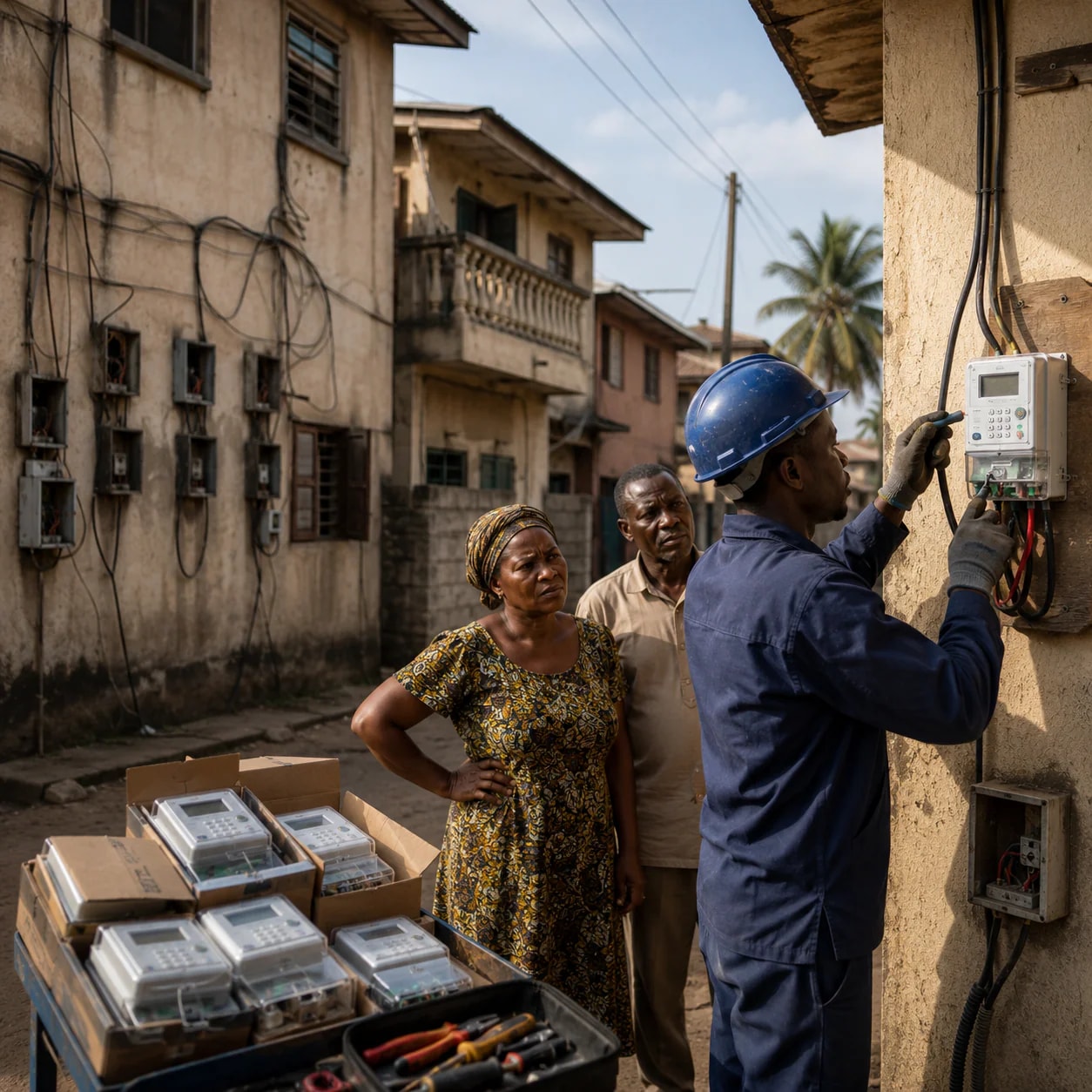
The supplied evidence confirms a substantial metering shortfall, but it does not substantiate the 6.75 million figure. December 2024 registered-customer data instead implies an arithmetic gap of about 7.21 million.
The 6.75 Million Claim and What Can Be Verified
The claim that Nigeria’s electricity metering deficit reached 6.75 million is not verified by the supplied evidence. The available industry figures report approximately 13.5 million registered electricity customers and 6.29 million metered customers across 12 distribution companies as of December 2024.
Those figures establish that fewer than half of registered customers were metered, but they do not produce a deficit of 6.75 million. Based strictly on the numbers provided, the difference between registered and metered customers was approximately 7.21 million. The 6.75 million figure should therefore be treated as unsubstantiated unless separate evidence explains its date, scope or calculation method.
What the December 2024 Registered-Customer Data Shows
As of December 2024, Nigeria’s 12 electricity distribution companies reportedly had about 13.5 million registered customers. Approximately 6.29 million of them had meters, producing a reported metering rate of 46.57%.
This means that less than half of the registered-customer base was recorded as metered. It also indicates a large population for which accurate billing based directly on measured consumption may be difficult. The source connects inadequate metering with problems such as billing disputes and collection challenges.
These figures describe registered customers in distribution-company records at a particular point in time. They should not automatically be interpreted as a count of all Nigerian households, all people receiving electricity or all premises connected to the grid.
Why the Available Figures Imply a Gap of About 7.21 Million
The calculation supported by the supplied December 2024 figures is straightforward:
– Registered customers: approximately 13.5 million – Metered customers: approximately 6.29 million – Arithmetic difference: approximately 7.21 million
The resulting 7.21 million is a calculation derived from the rounded figures in the source, not a deficit explicitly reported by that source. Because both inputs are expressed approximately, the result should also be presented as approximate.
Most importantly, this calculation does not validate the 6.75 million claim. A different figure could reflect another reporting date, customer category or methodology, but no such explanation appears in the supplied evidence. The defensible conclusion is therefore limited: the cited registered-customer figures imply a gap of about 7.21 million, while 6.75 million remains unverified here.
What the 2023 Household Survey Adds
A NOIPolls survey published in 2023 offers a consumer-level perspective. It reported that 57% of surveyed electricity customers had a meter at home, while 43% did not. Among respondents who had meters, 65% used prepaid meters. That prepaid group represented 37% of all respondents.
These findings help illustrate how metering conditions appeared among the people surveyed, but they do not replace the registered-customer data. The survey and the industry figures cover different periods and use different methods: one reports responses from electricity customers, while the other describes registered accounts across distribution companies.
The survey’s 57% meter-ownership result therefore cannot be directly compared with the December 2024 metering rate of 46.57% to infer that coverage increased or decreased. Each figure should be interpreted within its own population, method and reporting period.
How Metering Gaps Affect Bills and Consumers
Metering determines whether charges can be tied directly to recorded electricity consumption. The supplied industry reporting states that the absence of meters impedes accurate consumption-based billing and can worsen billing disputes and collection problems.
The 2023 survey gives additional context. Among respondents without meters, 62% said they paid through estimated or direct billing. For these customers, checking a bill against a meter reading may not be possible, making it harder to verify whether charges correspond to actual consumption.
The evidence does not establish that every unmetered customer experiences an incorrect bill. It does show why inadequate metering creates conditions in which charges may be more difficult to verify and disputes may be harder to resolve. That uncertainty affects consumers seeking transparent bills and distribution companies seeking to collect payment.
Metering, Supply Shortfalls and Alternative Power Sources
The survey placed metering concerns within a wider pattern of limited electricity supply. It reported that 68% of surveyed electricity customers received fewer than nine hours of supply per day, including 5% who said they received no electricity at all.
Among unmetered respondents, 21% reported using generators and 14% reported using solar power. These results indicate that some members of the unmetered group also relied on alternative sources of electricity.
The findings should not be used to claim that lacking a meter caused respondents to adopt generators or solar systems. The evidence reports these conditions within the same surveyed group but does not demonstrate causation. It does, however, show that metering problems existed alongside significant supply constraints and the use of alternative power sources among some respondents.
Why the Deficit Matters to Distribution Companies
The metering deficit is also a commercial and operational concern for electricity distribution companies. According to the supplied reporting, inadequate metering can interfere with accurate billing, intensify disputes and make revenue collection more difficult.
The same source reports that distribution companies’ aggregate technical, commercial and collection loss rate increased from 36.36% in the first quarter of 2024 to 39.10% in the third quarter. It separately reports a technical and commercial loss rate of 39.6% for the first quarter of 2025.
These measurements should not be treated as identical: the 2024 figures include collection losses, while the stated 2025 measure is described as technical and commercial losses. Nor do the supplied facts quantify how much of either rate was caused by inadequate metering. They nevertheless show that the metering shortfall exists within a sector facing substantial billing, collection and loss challenges.
Limits of the Available Evidence
The available evidence supports a careful assessment, not a definitive historical trend. The December 2024 figures concern registered customers across 12 distribution companies. The NOIPolls findings were published in 2023 and describe responses from surveyed electricity customers. Differences in timing, population and methodology mean the two datasets cannot be directly compared to calculate a change in metering coverage.
The supplied materials also contain no evidence establishing search-volume growth, Google Trends activity or a breaking-news event. They do not explain or substantiate the headline figure of 6.75 million.
Finally, the approximately 7.21 million gap is derived from rounded reported totals. It is useful for checking the internal arithmetic, but it should not be represented as a more precise official count than the underlying figures permit.
What Readers Should Take Away
Nigeria’s electricity metering deficit is substantial, but the supplied evidence does not verify that it reached 6.75 million. The December 2024 figures—approximately 13.5 million registered customers and 6.29 million metered customers—produce an arithmetic difference of about 7.21 million and a reported metering rate of 46.57%.
The 2023 survey adds evidence of consumer exposure to unmetered and estimated or direct billing, limited daily supply and some reliance on generators or solar power. It should be read as a separate snapshot rather than compared directly with the later registered-customer data.
Readers assessing the deficit should check the date, population and methodology behind any figure. On the evidence available here, about 7.21 million is the supported approximate calculation; 6.75 million is not established.
Disclosures and limitations
– This article was prepared with AI assistance and is based exclusively on the two sources identified in the supplied research package. – The approximately 7.21 million gap is an arithmetic calculation using rounded reported totals; it is not presented as a separately published official figure. – The 6.75 million claim is not substantiated by the supplied evidence. – This article contains no product recommendations or affiliate links.
Sources
– The Zionists are Failing to Cover Up Their Lies, And a New Ukrainian War Crime — sonar21.com – NIGERIAN ELECTRICITY REGULATORY COMMISSION — nerc.gov.ng – Only 57 Percent of Nigerian Electricity Customers are Metered — NOIPolls – World Happiness Report – Wikipedia — en.wikipedia.org – Nigeria raised electricity prices to improve supply. Why it hasn’t worked — The Conversation – Nigeria | Where we work | Global Energy Alliance for People and Planet — Global Energy Alliance for People and Planet – Gas Role in Energy Transition Despite Battery Dominance | Marija Petkovic posted on the topic | LinkedIn — LinkedIn – Sources — climateactiontracker.org – Breaking the Mold: The Evolution of US-Pakistan Cooperation Beyond Security • Stimson Center — Stimson Center – Electricity sector in Nigeria – Wikipedia — en.wikipedia.org