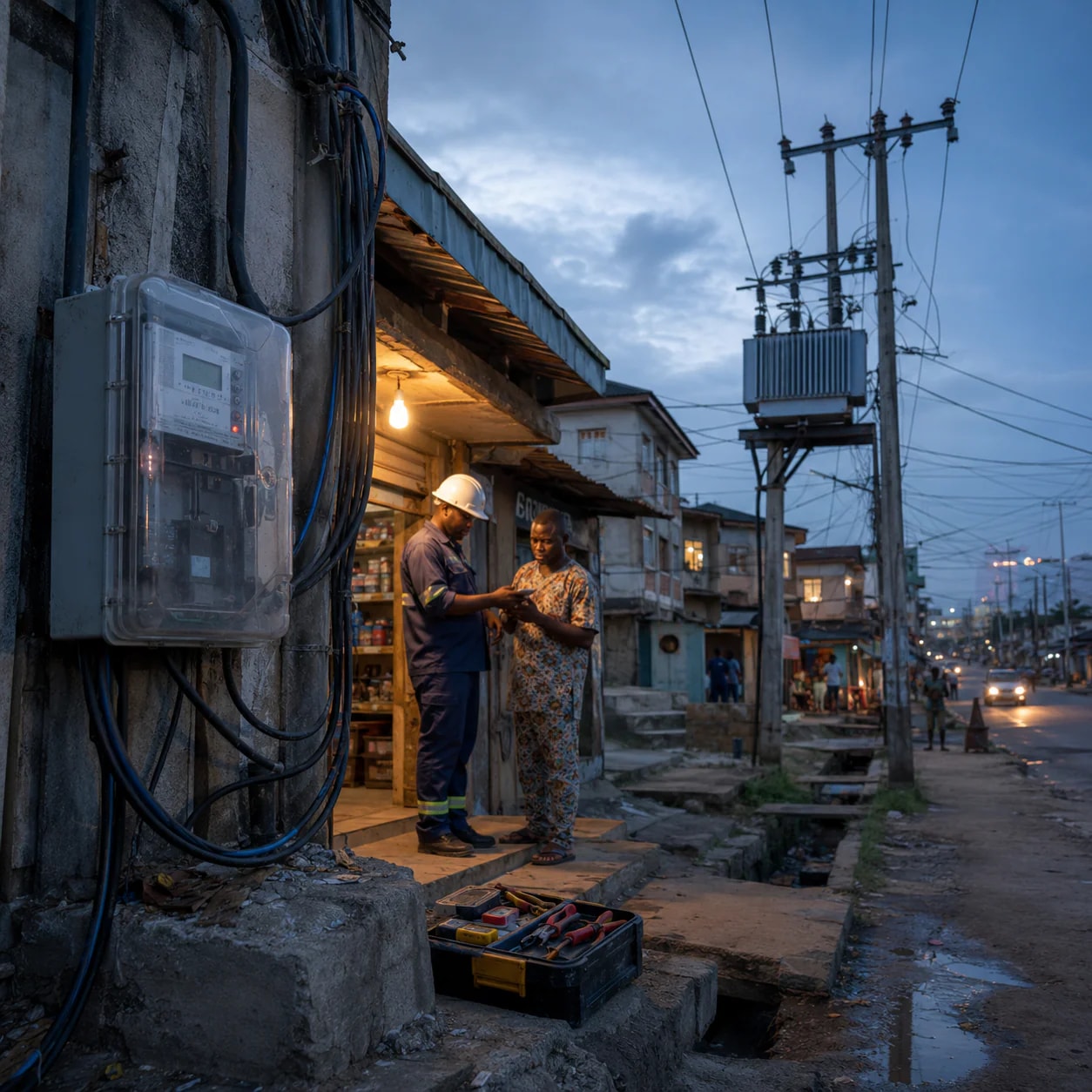
Nigeria’s electricity-pricing debate is not only about the tariff per kilowatt-hour. Sector liquidity also depends on service delivery, metering, distribution losses, collections and the amount of required revenue that the market actually recovers.
What power-sector liquidity and cost-reflective tariffs mean
Power-sector liquidity describes whether enough cash moves through the electricity market to meet the financial obligations associated with supplying power. A tariff may be designed to recover approved costs, but the sector can still face a liquidity shortfall when electricity is lost, bills are disputed or issued inaccurately, or billed amounts are not collected.
Under Nigeria’s multi-year tariff-order framework, the revenue requirement used in setting tariffs includes operating costs, capital recovery and a regulated return on assets. That requirement is divided by the volume of electricity that is actually billed and paid for. The denominator therefore matters as much as the approved costs: if less electricity is successfully billed and collected, the tariff needed to recover a given revenue requirement comes under upward pressure.
“Cost-reflective” consequently does not mean that every inefficiency should simply be transferred to customers. It describes the relationship between allowed revenue and the costs the tariff is intended to recover. As a conceptual comparison—not a statement of Nigerian law—the EU Agency for the Cooperation of Energy Regulators says network tariffs should be cost-reflective, transparent and non-discriminatory. Its European framework separates the process into determining allowed revenue, designing the tariff structure and allocating costs to charges. Nigeria has its own regulatory framework, but that distinction helps explain why the total revenue requirement and the way charges are assigned are related yet separate questions.
How Nigeria’s service-based tariff framework developed
Nigeria introduced a service-reflective tariff structure in 2020 that classified customers into Bands A through E according to the daily supply hours available in their locations. At that time, customers in Bands D and E were not covered by the tariff adjustment.
This framework made the expected level of service central to electricity pricing. Instead of treating all customers as though they received an identical supply, it linked tariff categories to the number of hours of electricity a location was expected to receive each day. That link also sharpened a persistent consumer question: if a customer is assigned to a higher-service category and pays the associated price, does actual supply consistently match that classification?
The 2020 material is useful for understanding how the service-band approach emerged, but it should not be treated as evidence of today’s rates or the current classification of a particular customer. Those details require current information from the relevant distribution company and regulator.
What changed for Band A customers in April 2024
In April 2024, the documented tariff for affected Band A customers rose from ₦67 to ₦225 per kilowatt-hour. Band A was identified with customers receiving at least 20 hours of electricity supply per day. The increase was more than 240%, making the relationship between price and delivered service especially important for affected consumers.
These figures describe the April 2024 change and should not be read as a universal or necessarily current tariff for every Nigerian electricity customer. The increase was directed mainly at Band A rather than all service categories. A customer assessing a bill must therefore establish the applicable date, distribution company, assigned band and current approved tariff instead of relying on the historical figure alone.
For sector finances, the change increased the amount that could be billed for qualifying electricity supplied to affected customers. It did not, by itself, guarantee that the full amount would be collected or that losses elsewhere in the distribution system would decline.
Why higher tariffs do not automatically close the liquidity gap
Raising a tariff changes the potential revenue associated with each successfully billed and collected unit of electricity. Liquidity, however, depends on how much of that potential becomes usable cash within the market.
Technical losses reduce the electricity available for billing. Commercial losses arise when delivered electricity is not properly measured or billed, while collection failures leave part of the billed amount unpaid. Together, these problems can keep actual revenue well below the level assumed in a cost-recovery calculation.
This produces a difficult feedback loop. A regulated revenue requirement must be recovered from the electricity that is effectively billed and paid for. When the recoverable volume is reduced by losses or weak collection, unrecovered revenue adds pressure to the amount the tariff system must obtain. Yet larger bills can also intensify affordability concerns and disputes, particularly when customers do not see service improvements or lack meters that provide clear consumption records.
The central policy issue is therefore not simply whether tariffs rise. It is whether higher billing rates are accompanied by lower losses, more accurate metering, stronger collection and service that matches the customer’s assigned category. Without progress in those areas, a tariff increase can coexist with continued cash shortages across the sector.
Distribution losses and the scale of unrecovered revenue
Reported distribution performance shows why tariff changes alone may be insufficient. Across Nigeria’s distribution companies, aggregate technical, commercial and collection losses were reported at 36.36% in the first quarter of 2024. The figure increased to 39.10% in the third quarter.
A related analysis reported aggregate technical and commercial losses of 39.6% for the first quarter of 2025, compared with a regulatory-framework target of 20.5%. On that basis, the reported loss rate was close to twice the target. The analysis associated it with an estimated ₦200.5 billion in lost revenue for the quarter.
The loss measures are not presented identically: the 2024 figures explicitly combine technical, commercial and collection losses, while the first-quarter 2025 figure is described as technical and commercial losses. They should therefore be read according to their stated definitions rather than treated as a perfectly uniform time series.
Even with that qualification, the figures point to a substantial gap between electricity entering the distribution process and revenue recovered from customers. Reducing that gap could improve liquidity without relying exclusively on further price increases. Most of these figures in the supplied research come from a secondary analysis; the underlying regulatory reports were not provided for independent cross-checking here.
Metering gaps, estimated billing and consumer trust
As of December 2024, 6.29 million of the 13.5 million registered customers served by Nigeria’s 12 distribution companies reportedly had meters. That represents a metering rate of 46.57%, leaving more than half of registered customers without a meter at that point.
A large metering gap complicates the connection between consumption, billing and payment. When a customer lacks a meter, estimated billing can generate disputes about whether the amount charged corresponds to electricity actually used. Those disputes can weaken willingness to pay and make collection more difficult, worsening the same liquidity problem that tariff reform is intended to address.
Metering is therefore both a consumer-protection and revenue-recovery issue. A reliable consumption record gives customers a clearer basis for reviewing charges and gives distribution companies a stronger basis for billing. Expanding metering does not by itself eliminate every technical, commercial or collection loss, but the reported gap shows why tariff policy cannot be evaluated separately from billing accuracy and customer confidence.
The consumer question: are higher bills matched by better supply?
For consumers, the practical test of a service-reflective tariff is whether the paid service category corresponds to electricity actually delivered. This concern became more pronounced after the April 2024 increase affecting Band A customers, whose category was associated with at least 20 hours of daily supply.
Consumer reactions documented when the service-based framework was introduced in 2020 included the view that tariff increases should be tied to stable supply. Some consumers also worried that a large increase could force them toward self-generation. Those comments are historical evidence of consumer concerns, not proof of what every customer experiences today.
The available figures nevertheless explain why the concern persists. High distribution losses and a metering rate below half of registered customers can make it harder for consumers to see a clear link between a higher tariff, an accurate bill and improved reliability. At the same time, weak revenue recovery constrains the sector’s cash position.
A useful assessment should therefore separate three questions: what service band a customer is officially assigned, how many hours of supply the location actually receives and whether the billed consumption is supported by meter records. A higher price and better service may be intended to operate together, but the price change alone does not demonstrate that the service improvement has occurred.
How electricity costs affect businesses and customers beyond the power sector
The consequences of unreliable or expensive electricity extend beyond utilities and household bills. The supplied research identifies logistics companies as one affected group: unreliable power and high operating costs add to the financial burden of running their businesses.
Local operators may have less capacity to absorb these costs. When operating expenses cannot be absorbed, businesses may pass some of the burden on to customers. Electricity-sector performance can therefore influence the prices consumers face elsewhere in the economy, even when electricity is not the product being sold.
This wider effect reinforces the importance of addressing reliability and efficiency together. An electricity tariff may be designed around the sector’s revenue needs, but businesses and their customers ultimately experience the combined effect of the tariff, the reliability of grid supply and the cost pressures created by unreliable power.
The fiscal dimension of the liquidity shortfall
Power-sector liquidity is also a public-finance issue. According to figures attributed in the supplied analysis to the Nigerian Electricity Regulatory Commission’s 2024 annual report, the federal government was responsible for ₦1.94 trillion of the reported funding gap. That represented 62.59% of the amount due and averaged more than ₦161 billion per month.
This illustrates how inadequate market recovery can shift financial pressure beyond distribution companies and other electricity-market participants. When customer payments and sector collections do not cover the required amounts, government support may be used to bridge part of the difference. That creates a claim on public resources while financial obligations within the electricity market remain unresolved.
The affordability problem is consequently shared across several fronts. Consumers face the immediate effect of higher bills; market participants need enough cash to meet sector obligations; and government faces the fiscal consequences of a large funding shortfall. A durable response must consider all three rather than treating a tariff increase as a complete liquidity strategy. The supplied material does not include the original annual report for direct verification, so the figures should be read as attributed secondary reporting.
What could improve affordability and sector liquidity together
A reported statement by Nigeria’s power minister in October 2024 outlined a policy direction based on increasing generation, improving distribution, raising efficiency and reducing losses, with the aim of lowering tariffs. This was a stated commitment, not evidence that lower tariffs or the proposed operational improvements had already been achieved.
The logic of that direction is consistent with the reported liquidity data. If a greater share of available electricity is accurately measured, billed and collected, more revenue can be recovered from the same underlying revenue base. Lower losses could reduce the pressure created when required revenue must be recovered from a smaller volume of paid electricity.
Progress would need to be assessed through observable results: falling technical and commercial losses, stronger collection, wider metering and service delivery that matches assigned bands. The supplied evidence shows substantial room for improvement, including the reported 39.6% technical and commercial loss rate in the first quarter of 2025 against a 20.5% target.
Affordability and liquidity are sometimes presented as opposing goals, but efficiency links them. Better recovery through lower losses and more credible billing could strengthen cash flow without placing the entire burden on the price per kilowatt-hour. Whether the announced policy direction delivers that outcome requires subsequent verified performance data.
What readers should verify when assessing tariff and service claims
Begin with current, location-specific information. Check the tariff published for the relevant distribution company, the effective date and the service band assigned to the premises. Historical reports explaining the 2020 service-band structure or the April 2024 Band A increase should not be assumed to state today’s rate.
Compare the assigned service category with recorded supply hours. Where a meter is installed, review consumption and billing records for consistency. Where billing is estimated, identify the basis of the charge and consult current official regulatory and distribution-company information when disputing or verifying it.
Treat announcements as claims to be tested against later results. The minister’s reported objective of improving efficiency and lowering tariffs describes policy intent, not an accomplished reduction. Similarly, use international principles only as conceptual references: the European cost-reflective tariff framework does not replace Nigerian rules.
Readers should also note the limitations of the available evidence. Several important loss, metering and funding-gap figures in the supplied package were drawn from one secondary analysis without the underlying regulatory documents. The 2020 service-tariff source is historical, and the report on the minister’s commitment is secondary reporting. Current official publications are therefore essential when making decisions about a specific bill, tariff or service claim.
Disclosures and limitations
– This article was prepared with AI assistance and is based only on the supplied research package and its identified sources. – Several central figures on losses, metering and the 2024 funding gap were supplied through a secondary analysis; the underlying regulatory reports were not included for direct cross-checking. Historical and policy-commitment sources are identified as such in the article. – The article contains no product recommendations or disclosed affiliate links. If commercial or affiliate links are added later, that relationship should be clearly disclosed and should not influence the analysis.
Sources
– Nigeria – Logistics Sector — International Trade Administration | Trade.gov – Nigeria’s Minister of Power Pledges Lower Electricity Tariffs as Power Generation Increases – Nigeriawide.com — Nigeriawide.com – Wikipedia:Artificial intelligence resources – Wikipedia — en.wikipedia.org – Network tariffs | www.acer.europa.eu — acer.europa.eu – Nigeria Development Update (NDU) — World Bank – Premiers push back against U.S. booze as Canada reacts to Trump’s latest tariffs — CTVNews – Nigeria | Where we work | Global Energy Alliance for People and Planet — Global Energy Alliance for People and Planet – New electricity tariffs in Nigeria 2020 hike for kilowatt unit of energy frustrate pipo from Ikeja to Abuja – See how much you go pay now & why NERC announce sudden hike – BBC News Pidgin — BBC News Pidgin – Nigeria Renewable Energy Market Growth | Industry Analysis, Size & Forecast Report — Mordor Intelligence – Nigeria raised electricity prices to improve supply. Why it hasn’t worked — The Conversation