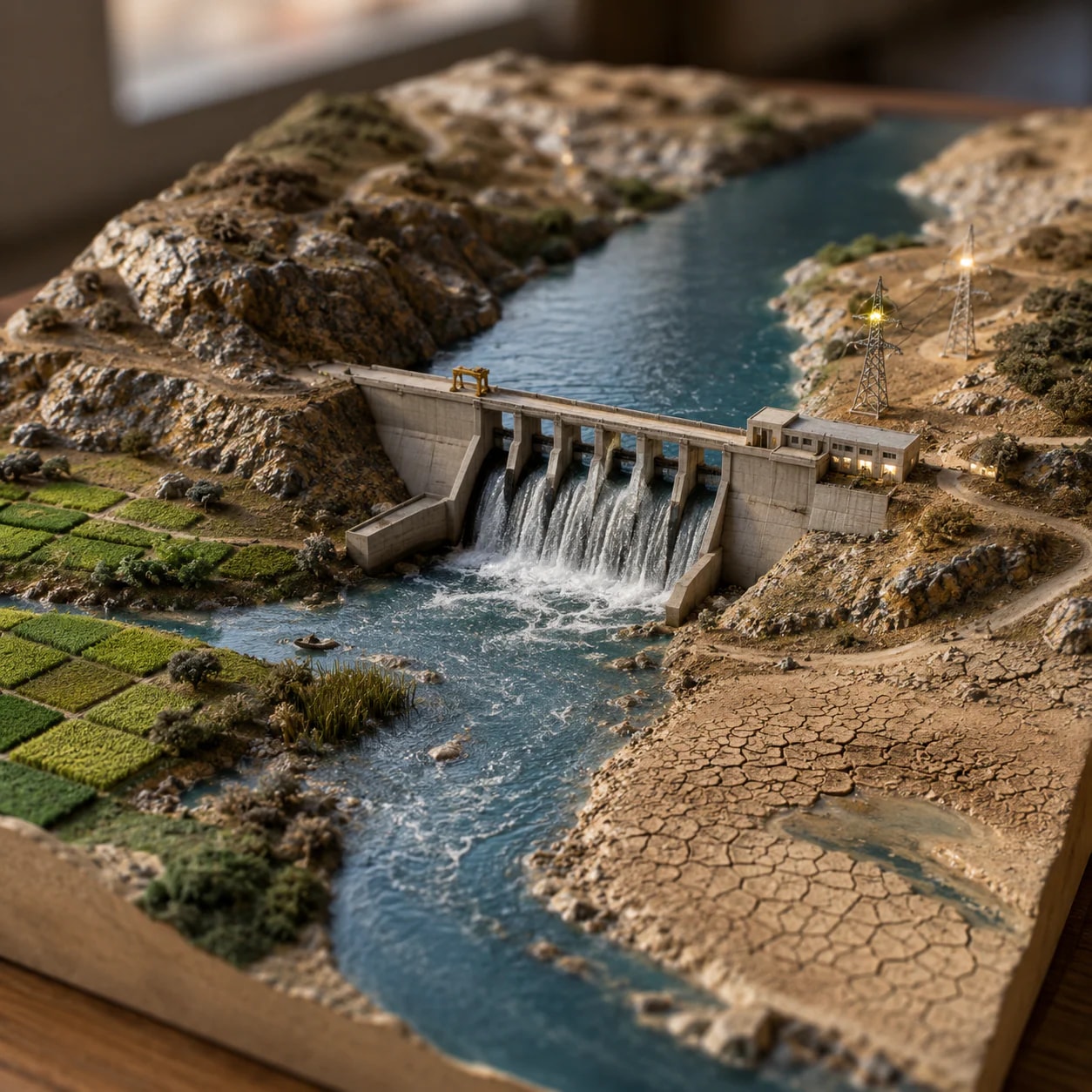
The dispute over Ethiopia’s Grand Ethiopian Renaissance Dam is about hydropower development, downstream water security and sovereignty—but its most difficult questions concern data sharing, drought management, coordinated operations and enforceable rules.
The Nile water dispute in brief
The Grand Ethiopian Renaissance Dam, or GERD, is on the Blue Nile. Ethiopia began constructing it in 2011 as part of a hydropower-led development strategy. The project has become the focus of a long-running disagreement with downstream Egypt over how the river should be managed.
Ethiopia presents the dam as a development and sovereignty issue and says downstream countries will not be harmed. Egypt wants a legally binding agreement governing the dam and is especially concerned about the reliability of water releases during a prolonged drought.
These positions should not be reduced to a claim that harm has already occurred. Recent reporting said abundant rainfall in the Ethiopian Highlands had, at the time reported, prevented a reduction in flows reaching Egypt. Separate research has modeled potentially serious shortages under particular filling scenarios, but those projections are not measurements of present conditions. The central question is therefore how the countries can manage future risks through coordinated operations, shared hydrological information and enforceable drought arrangements.
Why the GERD matters to Ethiopia
For Ethiopia, the GERD is tied to hydropower-led development and the country’s authority to use a river that originates within its territory. This helps explain why the disagreement is not simply about engineering calculations: rules for operating the dam also raise questions about who may influence Ethiopian infrastructure and development decisions.
Ethiopia has resisted foreign participation in operating the dam. Its position, as described in the supplied reporting, is that downstream countries will not be harmed. Ethiopian objections to external operational control consequently combine two concerns: preserving sovereign decision-making and protecting the development purpose associated with the project.
That position does not remove the need for cooperation. A dam on a shared river can affect how other states evaluate supply risks, particularly during dry periods. It does, however, explain why arrangements that appear to Egypt as necessary safeguards may be viewed in Ethiopia as unacceptable restrictions. Any durable settlement would have to address downstream predictability without effectively transferring control of the dam away from Ethiopia.
Why Egypt is concerned about downstream water security
Egypt’s central demand is for a legally binding agreement covering the GERD. Its concern is not limited to how much water reaches the country in a relatively wet period. It also includes how Ethiopia would manage releases if the Nile basin experienced a prolonged drought.
This distinction matters. Recent reporting indicated that abundant rainfall in the Ethiopian Highlands had prevented a reduction in flows reaching Egypt at the time covered. That observation describes conditions during a particular period; it does not establish what would happen under an extended dry spell or under different operating decisions.
From Egypt’s perspective, agreed rules could provide greater predictability about releases and define what each country should do when water is scarce. Ethiopia, meanwhile, has resisted foreign participation in operating the project and says downstream states will not be harmed. The unresolved issue is therefore not simply whether adequate water has recently arrived. It is whether the countries can agree in advance on obligations that apply when hydrological conditions become more difficult—and whether those obligations will be legally binding.
What modeling says—and what it does not prove
A 2021 study described by the University of Southern California modeled several scenarios for filling the GERD. It warned that rapid filling could substantially increase Egypt’s downstream water deficit under the modeled conditions.
That finding needs careful interpretation. A modeled scenario estimates what could happen when selected assumptions are applied; it is not evidence that the estimated deficit was subsequently observed. The study also addressed an earlier phase of the project, so its projections should not be presented as a measurement of current impacts.
The same USC account identified measures that could potentially reduce pressure on Egypt. These included adjusting operations at the Aswan Dam, using additional groundwater, changing crop choices and improving irrigation. The inclusion of these measures shows that the modeled consequences were not framed solely as a fixed result of the Ethiopian dam: downstream management decisions could also affect the scale of a shortage.
The study is therefore useful for identifying risks and possible responses, but it cannot by itself settle the political dispute. That requires current, jointly accepted hydrological information and agreed operating rules, especially for dry conditions.
How historic Nile agreements shape the disagreement
The dispute is influenced by disagreements over older rules for allocating Nile water. The 1929 and 1959 Nile agreements allocated water between Egypt and Sudan without Ethiopian participation. Ethiopia rejects those arrangements as colonial-era instruments that do not bind it.
This history produces fundamentally different starting points. An argument based on established downstream allocations may appear to Egypt as protection for existing water security. From Ethiopia’s perspective, relying on agreements from which it was excluded would restrict its use of the Blue Nile without its consent.
The significance of the older agreements is therefore broader than their specific allocations. They illustrate the unresolved question of how historical downstream expectations should be reconciled with the development claims of an upstream state that did not participate in those arrangements. Because the parties do not share the same view of the agreements’ authority, historical allocation rules have not provided an accepted basis for GERD operations.
Why existing legal frameworks have not settled the dispute
Several legal and political instruments form part of the dispute’s background: the 1997 UN Watercourses Convention, the Nile Basin Cooperative Framework Agreement and the 2015 Declaration of Principles. Yet the supplied legal analysis concludes that these instruments have not created an integrated, enforceable mechanism capable of resolving the GERD disagreement.
That limitation is important because broad principles do not automatically answer detailed operational questions. The parties still need rules addressing hydrological information, drought conditions, coordinated dam management and the handling of disagreements. They must also agree on whether those rules are binding and how compliance would be assessed.
The gap is consequently not an absence of legal concepts or diplomatic declarations. It is the absence of a framework that connects shared principles to specific operating obligations and an accepted enforcement or dispute-resolution process. Until that connection is made, each side can continue to interpret its rights and responsibilities differently, particularly when water conditions become more stressful.
The unresolved operational questions
The practical heart of the dispute is increasingly the operation of the dam rather than construction alone. A durable arrangement would need to address at least four connected areas: hydrological data sharing, management during prolonged drought, coordination between major dams and a process for resolving disputes.
Jointly accepted data would give the parties a common basis for evaluating river conditions, releases and downstream effects. Without that foundation, it is difficult to assess harm, assign responsibility or establish whether an agreed rule has been followed.
Drought management is especially sensitive. Egypt wants confidence about releases when water is scarce, while Ethiopia resists foreign participation in the dam’s operation. Negotiators therefore face the challenge of creating predictable safeguards without turning cooperation into external control of Ethiopian infrastructure.
Coordination also matters because downstream responses may include changes to the operation of other water infrastructure. Finally, any agreement would need to explain what happens when the parties interpret data or obligations differently. The cited analysis indicates that the existing legal landscape has not yet delivered an integrated, enforceable mechanism for that purpose. These questions remain unresolved despite repeated mediation efforts.
Why mediation has not produced a binding agreement
Multiple mediation efforts have failed to produce a binding trilateral agreement on GERD operations. The persistence of the impasse reflects a difficult trade-off at the center of the negotiations.
Egypt seeks enforceable protections for downstream water security, including clarity about dam management. Ethiopia says downstream countries will not be harmed but resists foreign participation in operating the project. A formula that is not binding may offer Egypt too little certainty, while a detailed enforceable regime may be seen by Ethiopia as compromising sovereignty over its infrastructure.
The legal context adds another obstacle. The cited analysis finds no integrated, enforceable mechanism emerging from the existing international and basin-level instruments. Historic Nile arrangements are also contested because Ethiopia was not a party to the 1929 and 1959 agreements and rejects them as colonial-era instruments.
Mediation has therefore had to address more than technical release schedules. It must bridge conflicting views of historical rights, sovereign authority, legal enforceability and acceptable risk. Repeated talks alone cannot resolve those differences unless the parties accept a common operational framework and a process for handling alleged breaches.
How wider Horn of Africa rivalries complicate the dispute
The GERD dispute increasingly overlaps with wider rivalries in the Horn of Africa. Supplied reporting and analysis connect it with debates over Red Sea access, military alignments and conflicts elsewhere in the region.
These links require careful attribution. Some assessments of regional intentions rely on news reporting, expert commentary or anonymous sources rather than official records. They should be treated as reported interpretations, not established statements of government strategy.
Even with that caution, the wider context matters. When relationships are affected by security competition and other regional disputes, technical negotiations over data, drought rules and releases can become harder to isolate from broader questions of trust. A concession on dam operations may be judged not only for its water implications but also through the lens of sovereignty and regional influence.
The Nile disagreement is therefore not adequately explained as a narrow engineering problem. Its operational questions are technical, but the willingness to compromise is shaped by a more complicated diplomatic environment.
What to watch next
The clearest indicator of progress will be movement toward a binding trilateral arrangement that converts broad commitments into workable operating rules. Readers should watch for provisions covering the exchange of jointly accepted hydrological data, coordinated dam management and releases during persistent drought.
A credible arrangement would also need a dispute-resolution process. Data sharing has limited value if the countries lack an agreed method for addressing conflicting interpretations, alleged harm or noncompliance. The strength of any enforcement provisions will therefore matter alongside the technical details.
Reported rainfall or river flows in a single period should not be treated as proof that long-term concerns have disappeared. Likewise, modeled shortages should not be reported as observed harm. The central test is whether Ethiopia, Egypt and Sudan can create predictable rules for both ordinary and difficult hydrological conditions while reconciling downstream security with Ethiopian sovereignty.
Follow Nigeria Electricity Hub for evidence-backed explainers on African hydropower, electricity policy and major regional infrastructure developments.
Disclosures and limitations
– This article was prepared with AI assistance from the supplied Research Package and approved Content Plan; no independent interviews, product testing or firsthand reporting were conducted. – Material claims are based only on the source-linked research supplied for this article. Several underlying sources are analysis, commentary or institutional summaries rather than primary treaty texts, official negotiating records or current dam-operation data. – No products are recommended in this article, and no affiliate relationship is represented. Any future commercial links should be clearly disclosed and independently reviewed before publication.
Sources
– Expedition to Ethiopia: Field Research and Workshops for Local Institutions — cgs.gov.cz – Ethiopia – Wikipedia — en.wikipedia.org – Egypt’s water dispute with Ethiopia overshadowed by rising Horn of Africa tension, experts say | The National — The National – Water dispute on the Nile River could destabilize the region — USC Today – How Israel is stuck between Ethiopia-Egypt clash over Nile | The Jerusalem Post — The Jerusalem Post | JPost.com – How water shortages are brewing wars — bbc.com – Ethiopia, Egypt, and the Nile: Why International Water Law Is Failing the GERD Dispute — jurist.org – The Nile at a crossroads: Navigating the GERD dispute as Egypt’s floodwaters rise — Atlantic Council – African challenges to multilateralism: the geopolitics of the Nile between conflict and cooperation — IAI – Istituto Affari Internazionali – Wikipedia:In the news/Candidates/July 2018 – Wikipedia — en.wikipedia.org