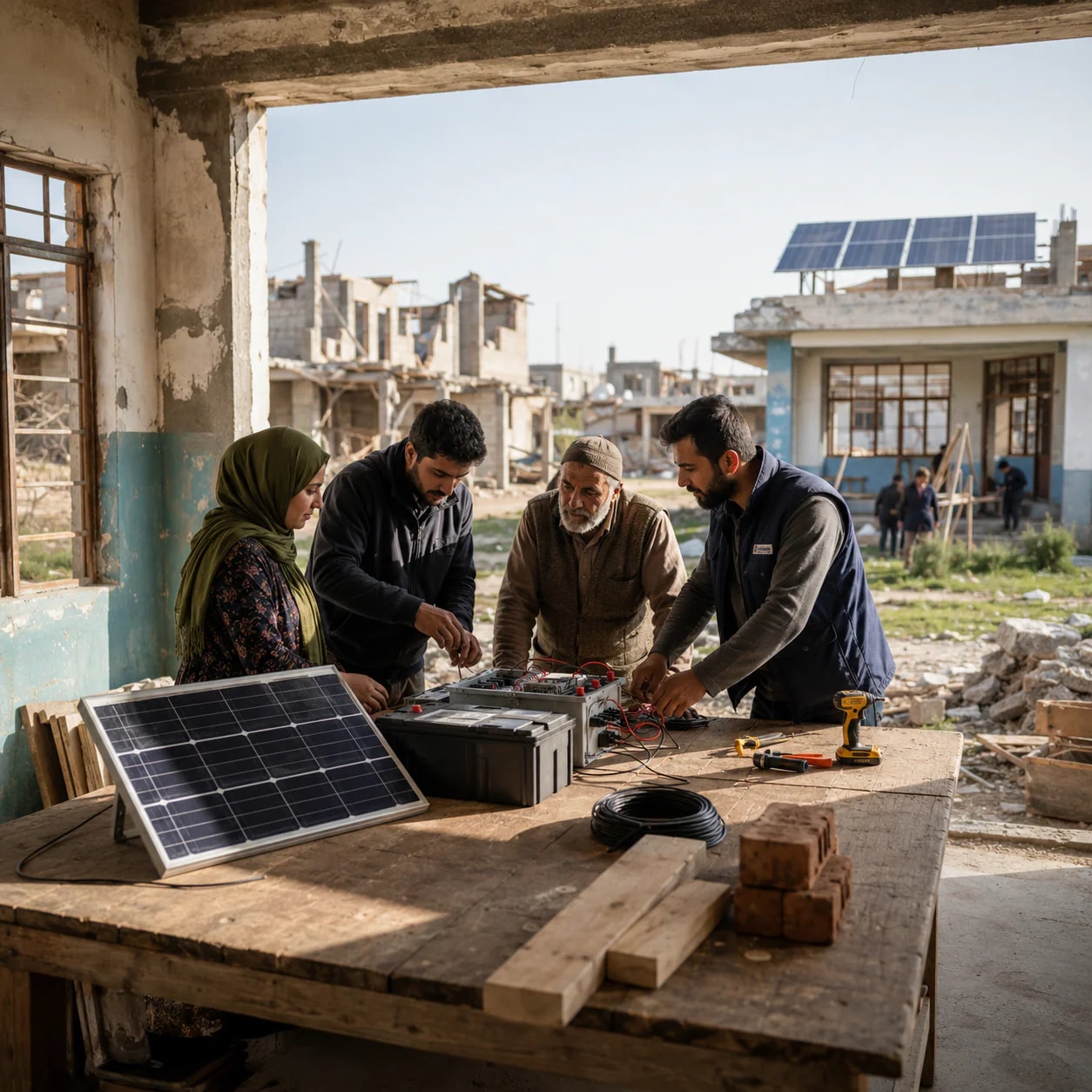
Community-level solar may be worth considering in Nigeria’s recovery planning, but the available evidence establishes humanitarian need and power-supply difficulties—not successful project outcomes.
What the Available Evidence Can—and Cannot—Establish
The available evidence establishes a difficult context for infrastructure recovery in Nigeria. Prolonged displacement, damaged social infrastructure and restrictions on humanitarian access affect conflict-affected communities, while residents across the country frequently experience power-supply difficulties. Separate technical evidence shows that solar and wind generation are variable and may require storage, demand management or grid upgrades to balance output.
These findings explain why community-level energy approaches may enter rebuilding discussions. They do not, however, prove that community solar is already supporting post-conflict recovery in Nigeria. The supplied sources contain no documented Nigerian project, measured rebuilding outcome or verified information about costs, ownership, financing, maintenance, security or operational performance. Community solar should therefore be treated here as a possible approach requiring investigation, not as an established solution.
The Post-Conflict Infrastructure Challenge in Nigeria
The humanitarian evidence indicates that displacement in Nigeria is both extensive and prolonged. The European Commission’s humanitarian aid page reports 3.7 million internally displaced people in the country and says about two-thirds have been displaced for at least five years. It also reports that 16 years of conflict in Borno, Adamawa and Yobe have internally displaced 2.3 million people and ravaged social infrastructure.
Rebuilding must also be considered against significant access constraints. According to the same source, violence and access restrictions prevent aid workers from reaching an estimated 400,000–500,000 people in north-east Nigeria. These conditions show that recovery is not simply a matter of replacing damaged infrastructure. Any proposed intervention must be assessed within an environment where insecurity, isolation and prolonged displacement can limit the delivery of essential services.
The source documents the scale of the humanitarian and infrastructure challenge, but it does not evaluate community solar or identify energy projects serving these populations.
Why Electricity Access Matters During Rebuilding
The case for examining electricity infrastructure during rebuilding arises from two documented conditions. Conflict has ravaged social infrastructure in Borno, Adamawa and Yobe, weakening the setting in which essential services are delivered. At the same time, the supplied overview of Nigeria’s economy says residents frequently experience power-supply difficulties and describes an ongoing supply crisis in the power sector.
Taken together, these conditions make electricity reliability a relevant part of recovery planning. They do not demonstrate which technology, delivery model or ownership structure would work best in a particular community. They also do not show that a community-solar system would overcome the physical-access and security constraints affecting isolated areas.
The distinction matters: evidence of damaged infrastructure and unreliable electricity establishes a problem, not proof of a proposed solution. Evaluators should require project-specific evidence before attributing improved access, stronger services or rebuilding outcomes to community solar.
Where Community Solar Could Fit
Community solar can be considered as a possible infrastructure approach where planners are responding to damaged social infrastructure and recurring electricity-supply difficulties. That conclusion is analytical rather than a reported Nigerian project result. The humanitarian source identifies prolonged displacement, infrastructure damage and communities that are difficult for aid workers to reach. The electricity-sector overview identifies frequent power-supply problems. Neither source assesses whether a community-solar model can resolve those conditions.
A proposal should therefore begin with clearly defined local needs and operating constraints rather than an assumption that solar deployment will produce recovery benefits. The supplied evidence cannot determine an appropriate system size, location, ownership model, financing structure or service arrangement. It also cannot establish expected costs or performance.
Community solar may be plausible enough to evaluate, but plausibility is not effectiveness. Claims that it supports post-conflict rebuilding in Nigeria require verified project records and measured outcomes that are absent from the current research package.
Reliability Requirements: Variability, Storage and Demand Management
Solar generation is variable. The supplied technical source states that variable solar and wind output may require storage, demand management or grid upgrades to keep electricity output balanced. Reliability therefore cannot be inferred from the presence of solar equipment alone.
For any proposed community-solar system, evaluation would need to address how variable output will be balanced under its intended operating conditions. Storage, managed demand and grid improvements are identified as possible balancing measures, but the research package does not say which measure—or combination of measures—is appropriate for a Nigerian post-conflict setting. It provides no project-level information about system design, operating performance or the condition of supporting infrastructure.
Consequently, broad claims about dependable service would be premature. A credible assessment needs evidence showing how the proposed design responds to variability and whether actual performance meets the project’s stated requirements.
Delivery Constraints in Conflict-Affected Areas
Delivery conditions may be as important as the proposed energy technology. The European Commission reports that violence and access constraints prevent humanitarian workers from reaching an estimated 400,000–500,000 people in north-east Nigeria. This documented restriction indicates that some affected communities are difficult to reach even for humanitarian assistance.
It is therefore reasonable to examine whether the same environment could complicate a proposed project’s delivery and continuing support. That is a planning question, not evidence that any particular solar installation has failed or succeeded. The supplied material contains no project-specific findings about installation, maintenance, security or local operating arrangements.
Evaluators should avoid assuming that a system can be delivered and sustained merely because it appears technically suitable. Verified information about the intended location and the practical conditions governing access would be necessary before reaching a project-level conclusion.
Evidence Needed Before a Project Can Be Judged
A community-solar rebuilding proposal should be judged with Nigeria-specific, project-level evidence. The current package establishes prolonged displacement, damaged social infrastructure, humanitarian access restrictions, frequent power-supply difficulties and the technical variability of solar generation. It does not provide the information needed to compare a project’s promises with its results.
Important evidence gaps include costs, ownership, financing, maintenance, security, performance and measured rebuilding outcomes. Technical documentation should also show how the system addresses variable generation through storage, demand management, grid upgrades or another evidenced arrangement. Because the sources do not supply these details, no conclusion can be drawn about affordability, durability or reliability for a particular project.
Verification should distinguish plans from completed work and expected benefits from measured outcomes. Readers assessing a proposal should seek documented Nigerian project data before accepting claims about costs, performance or recovery impact.
Conclusion: A Plausible Option That Still Requires Verification
Nigeria’s documented conditions provide a clear reason to investigate locally delivered electricity infrastructure. Millions of people are internally displaced, social infrastructure has been ravaged in conflict-affected states, access restrictions isolate some communities, and residents face recurring power-supply difficulties. Community solar may therefore be considered as one possible approach during rebuilding.
The available evidence does not establish that it has produced successful post-conflict outcomes in Nigeria. Solar variability may also require storage, demand management or grid improvements, making system design and operating conditions central to any reliability claim.
Community solar should be evaluated as a conditional proposition rather than a proven result. Decision-makers and readers should seek verified Nigeria-specific evidence on costs, ownership, financing, maintenance, security, performance and rebuilding outcomes before drawing conclusions.
Disclosures and limitations
– This article was prepared with AI assistance from the supplied research package and content plan; it does not draw on personal product use, purchases, testing or interviews. – Material claims are attributed through source IDs supplied with the research package. The package warns that two retained sources are Wikipedia pages and should be checked against original sources before publication. – No products are recommended in this article, and no affiliate relationship or commission is represented. Any future commercial recommendation should disclose relevant affiliate relationships clearly. – The supplied evidence does not directly document a community-solar project supporting post-conflict rebuilding in Nigeria; the article distinguishes documented conditions from analytical possibilities. – The site metadata lists the selection region as the United States, while the article and usable evidence concern Nigeria; editors should resolve this geographic inconsistency before publication.
Sources
– Wikipedia:Artificial intelligence resources – Wikipedia — en.wikipedia.org – Nigeria — European Civil Protection and Humanitarian Aid Operations – Government Negotiations: The Brittney Griner Case — PON – Program on Negotiation at Harvard Law School – Solar vs Wind Power Costs for Communities — linkedin.com – North Africa Regional Outlook: May 13, 2026 • Stimson Center — Stimson Center – Environmental issues in the Niger Delta – Wikipedia — en.wikipedia.org – Economy of Nigeria – Wikipedia — en.wikipedia.org – Climate change mitigation – Wikipedia — en.wikipedia.org – World Happiness Report – Wikipedia — en.wikipedia.org