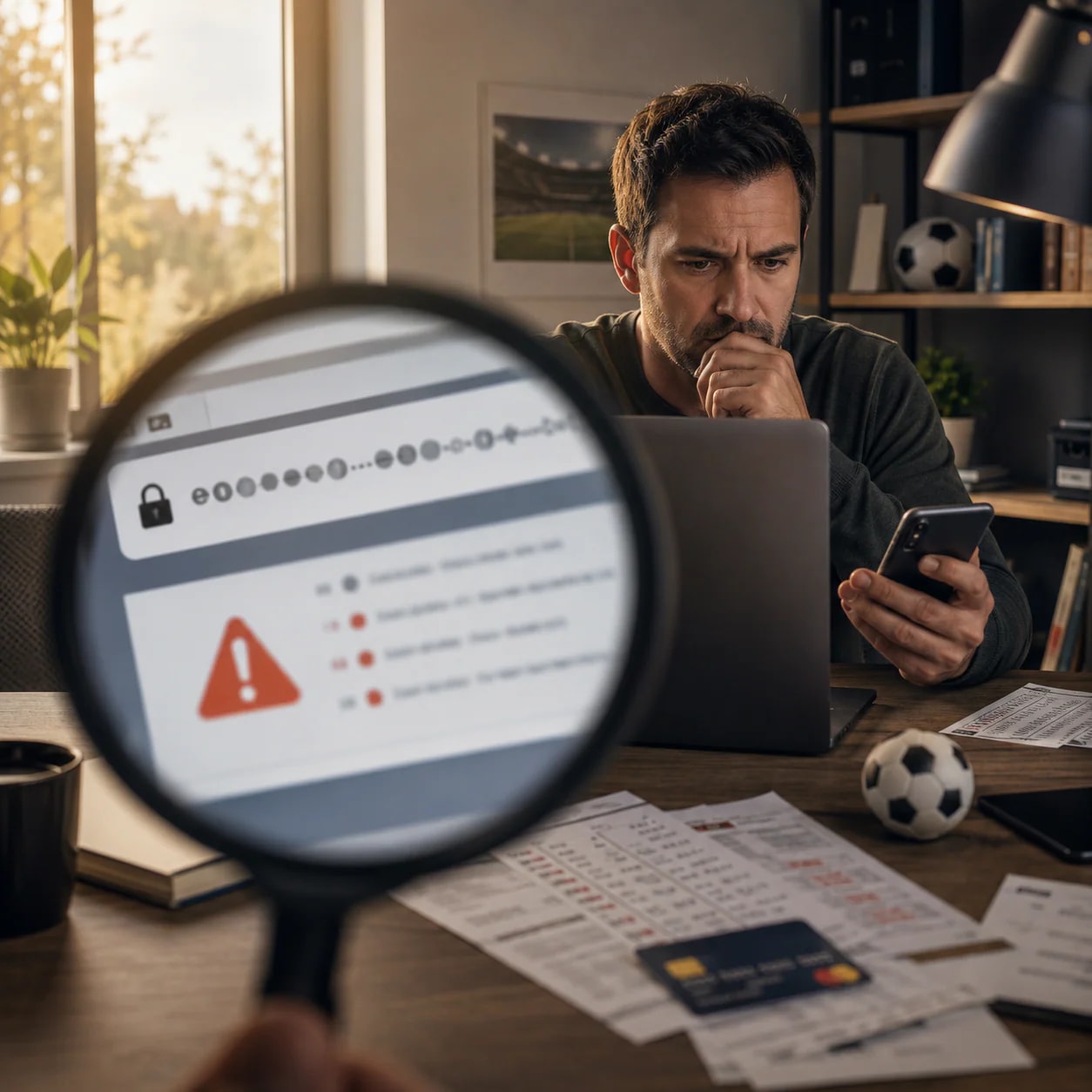
Unfamiliar destinations, urgent messages and unverifiable trust badges are reasons to pause. This guide explains how US readers can assess suspicious betting links without treating warning signs as proof of fraud.
Why opaque betting links deserve caution
An unclear betting link is a warning sign, not proof that the sender or destination is fraudulent. The safest response is to pause and verify rather than make an immediate accusation—or an immediate click.
CISA describes phishing as an attempt to persuade people to follow harmful links, open deceptive emails or download malicious attachments. These actions can expose sensitive information or install malicious software. Separate security reporting notes that spyware can also reach devices through phishing links, fraudulent text messages, social-media links and malicious email attachments, potentially putting account credentials and other data at risk.
These risks make opaque-link checks useful even when no money has been deposited. A betting-themed message may be an entry point to credential theft or device compromise rather than merely a questionable gambling offer. This article is a durable safety guide, not evidence of a current trend or a determination about any particular website.
What makes a URL opaque or difficult to assess
A URL becomes difficult to assess when the address shown to the recipient does not clearly reveal the destination. Shortened links can conceal the full domain. Unfamiliar or random-looking domains provide little recognizable context. A login button embedded in a message may show only words such as “Sign in” or “Claim offer,” leaving the underlying address out of sight.
These characteristics do not establish fraud. Short links and unfamiliar domains can have ordinary uses. They nevertheless remove information that would otherwise help a reader make a pre-click judgment, so they create a reason for additional verification.
CISA recommends hovering over a link without clicking to see where it actually leads. This can expose a mismatch between the message’s claim and the displayed destination. On devices or interfaces where a safe preview is unavailable or unclear, do not treat that limitation as a reason to open the link. Instead, locate the claimed organization independently.
Pay attention to the domain itself rather than relying only on the surrounding message, button label or recognizable branding. A message-based login entrance should not be assumed genuine merely because it resembles a familiar service. The appropriate conclusion at this stage is limited: the destination is unclear and should be verified before use.
Message-level warning signs: urgency, threats and unexpected requests
Suspicious messages often try to shorten the time available for reflection. A limited-time promotion, threatened fee or account-suspension warning may push a recipient to click, sign in or provide information before checking the domain and operator.
CISA identifies urgent wording, unexpected or unusual requests and suspicious links as phishing warning signs. Context matters: a request that departs from the normal way an organization communicates or asks for an unanticipated action deserves scrutiny. Urgency should increase caution rather than determine whether an offer is genuine.
Familiarity with the sender is not enough. CISA warns that a message can come from the compromised account of someone the recipient knows. Consequently, a recognizable name or an existing conversation does not eliminate the need to inspect the request and verify it through another route.
Consider the message and destination together. Pressure combined with an obscured link or an unverifiable betting claim presents more reasons to stop and check, but the combination still does not prove fraud. Do not reply to the suspicious message or rely on its embedded number or link for verification. Use contact information obtained independently instead.
Why polished design and trust badges are not enough
A professional-looking page can create confidence without establishing who operates it or whether its claims are reliable. Familiar payment logos, security icons, award graphics and license-style badges are visual assertions; by themselves, they do not verify an operator, license or withdrawal process.
Betting-safety material in the research package advises readers not to treat unverifiable license images, security symbols or awards as dependable proof. Useful trust information should lead to records and policies that can be examined. That includes a specific license, a privacy policy, payment rules and an identifiable support process.
A badge that cannot be connected to concrete information offers little basis for verification. Likewise, displaying a payment brand does not explain the operator’s deposit or withdrawal rules. Readers should look past the graphic layer and ask whether the underlying details are identifiable, internally consistent and available for review.
This is not a judgment that every polished page or badge is deceptive. It is a distinction between presentation and evidence: design can communicate a claim, while verifiable records and policies provide information with which that claim can be assessed.
A click-free process for checking a suspicious link
Use a cautious sequence that does not depend on the suspicious message to authenticate itself:
1. Pause without opening the link. Do not let a countdown, promotion, fee threat or account warning force an immediate decision. 2. Preview the destination where possible. CISA recommends hovering over a link without clicking to reveal the actual URL. Look for whether the destination corresponds to what the message claims. 3. Do not use the message as your verification channel. Avoid replying to the suspicious message and do not call a number or open a link supplied inside it. 4. Find the organization independently. Use contact information you already have or information located separately from the message. Contact the claimed organization through that independent route and ask whether the request is genuine. 5. Treat uncertainty as a reason to stop. If the destination cannot be previewed or the organization cannot be independently confirmed, do not enter credentials or other sensitive information.
This process does not require deciding immediately that a message is fraudulent. Its purpose is to separate verification from the channel that may be deceptive. An independent contact route is more informative than a reply to the same sender, while a visible destination gives the reader more evidence than a button label alone.
Checks specific to online betting claims
After checking the message and URL, assess whether the betting service provides information that can actually be verified. Look for an identifiable operator, specific licensing information, privacy terms, payment and withdrawal rules, and a defined support procedure. A graphic that merely resembles a license or security seal is not a substitute for those details.
Pay particular attention to the distinction between a payment logo and payment rules. The presence of familiar branding does not explain how deposits or withdrawals are handled. Similarly, a support icon does not by itself establish what help is available or how disputes are addressed.
These checks have limits. The betting-specific safety source in the research package is directed at a New Zealand audience. Its transparency checks can help US readers ask sensible questions, but the source is not authoritative evidence about whether a service is legal in a particular US jurisdiction.
Historical material concerning *United States v. Scheinberg* records that the US Department of Justice seized the .com domains of three online gambling sites, after which the companies stopped offering real-money play to US customers. That history shows why availability alone is an inadequate legal test, but it cannot determine the status of a current operator. Current legality or authorization requires current, service-specific and jurisdiction-relevant evidence that is not supplied in this research package.
Accessibility does not establish legality or legitimacy
The ability to reach a website does not prove that its services are lawful, authorized or trustworthy for a US user. Accessibility is only a technical fact: the page loaded. It does not answer who operates the service, what rules apply or whether its claims are accurate.
The historical *United States v. Scheinberg* material offers limited background. It records that the US Department of Justice seized three online gambling sites’ .com domains and that the businesses subsequently stopped providing real-money games to US customers. This example illustrates that a domain’s presence and accessibility should not be treated as a complete legal assessment.
The case is historical and cannot be used to label any current site legal, illegal or fraudulent. Readers assessing a present-day claim need current, authoritative information about the specific service and relevant jurisdiction. Page appearance and availability cannot supply that evidence.
What can happen after clicking a malicious link
The possible harm from a malicious link extends beyond losing money through a betting offer. CISA states that phishing can expose sensitive information or result in malicious software being installed. Security reporting also indicates that spyware may arrive through phishing links, fraudulent texts, social-media links or malicious attachments and may steal credentials and other device data.
These are possible outcomes, not a claim that every unclear link contains malware or steals information. The uncertainty is precisely why pre-click checks matter. Once credentials have been entered or software has been installed, the risk may involve accounts and device data in addition to any funds associated with a betting service.
A cautious approach therefore protects more than a potential deposit: it reduces exposure of login details and other information before the destination has been verified.
Limits of warning-sign analysis
Warning signs support caution; they do not deliver a verdict. A short link, unfamiliar domain, urgent message or unverifiable badge may justify further checking, but none independently proves that a present-day platform or offer is fraudulent.
The research package notes that domain infrastructure continues to appear in scam and phishing activity, including IC3 alert listings related to cryptocurrency investment-scam infrastructure and phishing-as-a-service platforms. Those alerts cannot establish that an unrelated current domain is malicious.
Other evidence here has similar boundaries. The short-link material is supplementary rather than an official finding, while the historical gambling case cannot resolve the legal status of a current operator. Some cited material also lacks a publication date or is older.
Any firm conclusion about a specific service should rest on current, authoritative evidence concerning that service. Until such evidence is available, describe observed features precisely—such as an obscured destination or unverifiable license image—without turning them into an unsupported allegation.
Quick pre-click checklist
Before opening an unfamiliar betting link or entering information, ask:
– Can I inspect the actual destination without clicking? – Does the message use urgency, threats or an unexpected request to push immediate action? – Can I verify the claim through contact information obtained independently, rather than through the message’s link or number? – Is the operator identifiable beyond the page’s branding? – Do license-style badges connect to specific, verifiable information? – Are privacy terms, payment and withdrawal rules, and support procedures available for review? – Am I treating polished design or website accessibility as proof when neither establishes reliability or legality?
If the destination or operator remains unclear, pause rather than submit information. The practical rule is simple: inspect the destination, resist pressure and verify the organization through an independent route.
Disclosures and limitations
– This article was prepared with AI assistance from the supplied research package and follows its approved content plan. – Material claims are attributed through the accompanying source IDs. The sources have limitations: some are older or undated, the betting-specific guidance is aimed at a New Zealand audience, the short-link material is supplementary, and the cited US gambling case is historical. – This guide does not determine that any current domain, platform or offer is fraudulent, legal or authorized. Such conclusions require current, authoritative and service-specific evidence. – No products or betting services are recommended, and the supplied research package identifies no affiliate relationship. Any future commercial recommendation should clearly disclose potential affiliate compensation and its associated conflict-of-interest risk.
Sources
– Industry Alerts – Internet Crime Complaint Center (IC3) — ic3.gov – United States v. Scheinberg – Wikipedia — en.wikipedia.org – These warning signs could mean spyware is on your phone – and 9 ways to keep it secure — ZDNET – Digital Safety | Policies — microsoft.com – How to Identify Sms Phishing Scams — linkedin.com – Teach Employees to Avoid Phishing | CISA — Cybersecurity and Infrastructure Security Agency CISA – Scam Casino Warning Signs NZ – Safety Guide — Casino Kingdom – Industry Alerts – Internet Crime Complaint Center (IC3) — ic3.gov – Industry Alerts – Internet Crime Complaint Center (IC3) — ic3.gov – Industry Alerts – Internet Crime Complaint Center (IC3) — ic3.gov