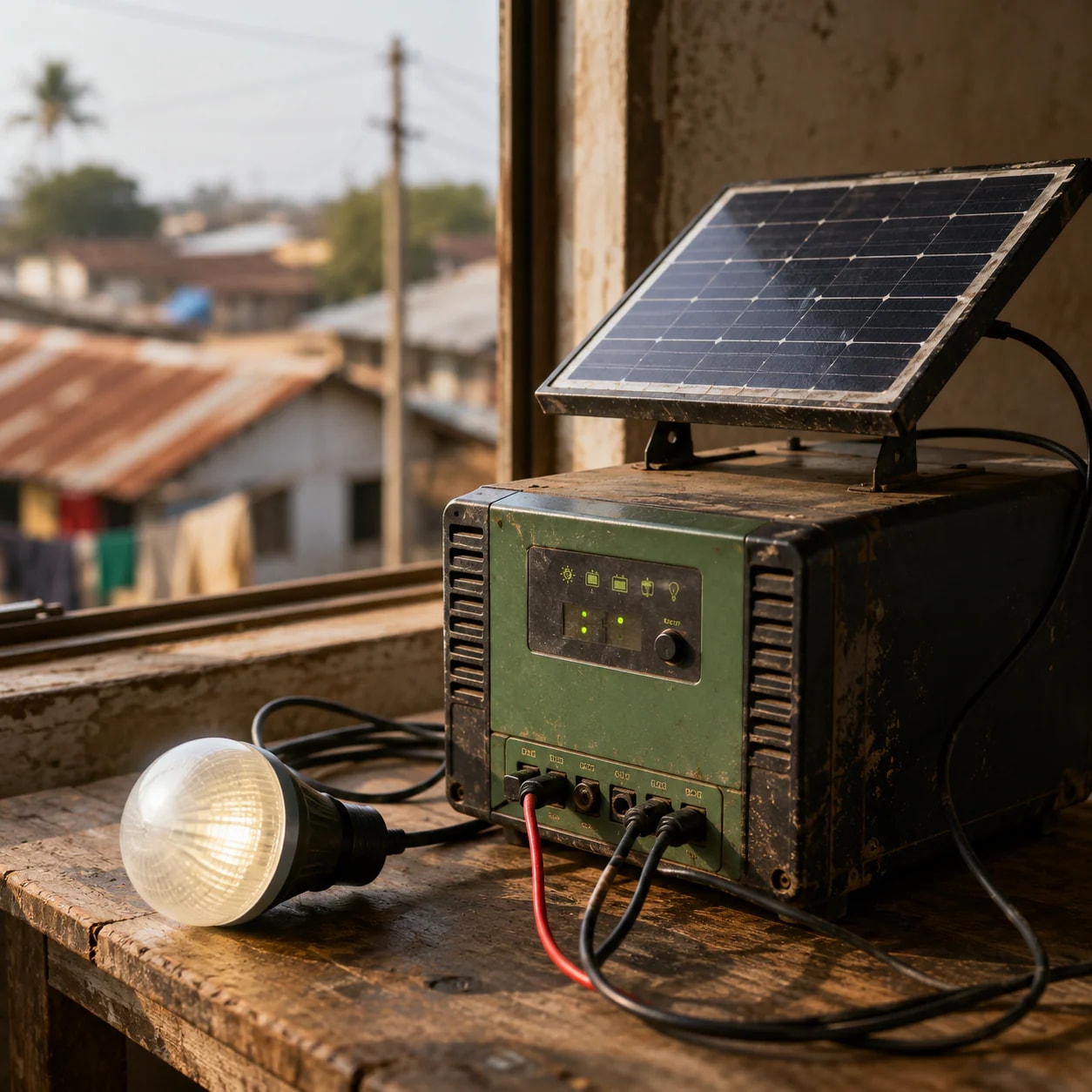
Africa has extensive renewable resources and a large electricity-access deficit, but converting its potential into reliable supply depends on delivery models, investment, regulation, infrastructure and country-specific planning.
Africa’s renewable energy opportunity and electricity-access gap
Africa’s renewable energy prospects are defined by a striking contrast between resource potential and access to electricity. The European Commission reports that the continent holds 60% of the world’s best solar resources but attracts only 3% of global energy investment. It also estimates that about 600 million people—mainly in sub-Saharan Africa—still lack electricity access.
A separate March 2026 overview from Statista describes the access deficit as more than half a billion people without electricity connections. These estimates use different wording and should be retained with their respective attributions rather than combined into a single supposedly definitive figure.
Together, the figures show why renewable energy is discussed as both a development opportunity and an implementation challenge. Strong solar resources could support additional generation, while the scale of the access deficit indicates that resource availability has not automatically produced universal service. Investment levels, infrastructure, delivery systems and institutional capacity influence whether potential capacity becomes dependable electricity for households and other users.
The central question is therefore not simply how much renewable energy Africa could produce. It is how projects can be financed, approved, built and connected—or delivered through decentralised systems—in ways that expand reliable access.
What the current electricity mix reveals
Statista’s March 2026 overview says renewable sources account for nearly 18% of Africa’s electricity output. Because this is a continent-wide summary, it does not describe the mix of every African country. It also indicates that renewables, although already contributing to electricity production, remain only one part of the wider supply picture.
Nigeria illustrates why national context matters. A U.S. International Trade Administration guide published in June 2023 reported that Nigeria generated most of its electricity from thermal and hydro sources and had about 12,522 MW of installed capacity at that time. Those figures should be read as a dated description of Nigeria, not as a current measurement or a proxy for Africa as a whole.
The two sources also measure different things. The Statista figure concerns renewable electricity output across Africa, while the trade guide describes Nigeria’s generation sources and installed capacity in 2023. Installed capacity is not presented in the supplied evidence as equivalent to electricity actually generated or delivered.
This distinction is important when assessing renewable-energy prospects. Continental percentages can reveal broad direction, but decisions about generation, networks or access require country-level information with clear dates and definitions. For Nigeria, the available evidence supports a mixed power-system context in which thermal and hydro generation were prominent in 2023; it does not establish the country’s current renewable share.
Where renewable resources and delivery models offer potential
Renewable potential is not distributed uniformly across Africa. The supplied resource overview describes solar resources as widespread, while wind and geothermal potential are more dependent on location. This variation means that a technology suitable for one area cannot automatically be assumed to fit another. Resource type, geography and the intended users all affect the appropriate project model.
Delivery systems can also differ. Bridgespan presents centralised and decentralised energy as complementary parts of Africa’s transition. Centralised systems can contribute generation through larger facilities, while decentralised approaches can include mini-grids and pay-as-you-go solar. The evidence does not support treating either model as a universal replacement for the other.
This complementary framing is particularly relevant to the electricity-access gap. Different places may require different combinations of supply. A centralised project and a decentralised system serve distinct roles, and the supplied evidence supports considering both within the broader transition. The choice should be connected to local renewable resources and the practical requirements of delivering electricity.
Decentralised models still require viable financing and project structures. Bridgespan identifies blended finance, guarantees and results-based financing as possible mechanisms for attracting investment into mini-grids and pay-as-you-go solar. These are potential tools rather than proof that every project will be commercially or operationally successful.
Africa’s opportunity therefore consists of more than a large theoretical resource base. It includes the ability to match geographically appropriate resources with centralised or decentralised delivery models. Realising that opportunity depends on whether the selected model can overcome the regulatory, financial and institutional constraints surrounding project development.
Investment commitments and stated capacity targets
Several announced initiatives indicate the scale of external interest in African renewable energy, but their figures must be described as pledges, expectations or targets—not completed results.
According to the European Commission, the Scaling Up Renewables in Africa campaign secured €15.5 billion in pledges. The associated commitments are expected to add 26.8 GW of renewable generation and extend renewable electricity to 17.5 million households that lack reliable access. These numbers describe anticipated effects linked to commitments; they do not establish that all financing has been disbursed, all capacity commissioned or all households connected.
The European Commission also states that the Africa-Europe Green Energy Initiative aims to deploy at least 50 GW of new renewable electricity capacity and provide electricity access to at least 100 million people in Africa by 2030. The 2030 date and the word “aims” are essential to interpreting these figures. They represent stated objectives against which later delivery can be assessed.
These announcements show that renewable expansion and electricity access are being considered together. They also provide measurable categories—pledged finance, planned capacity and intended household or population access—that can be tracked separately. Assessing progress would require current primary-source reporting on financing, construction, commissioning and connections. The supplied figures alone support the existence and scale of the commitments, but not a conclusion that their projected outcomes have already been achieved.
Regulatory and project-development limits
Renewable projects can face obstacles before construction or operation begins. Bridgespan identifies unclear tariffs, slow permitting, overlapping institutional responsibilities and changing regulatory frameworks as factors that can delay projects or increase their costs.
Tariff uncertainty can make the expected revenue environment less clear. Slow permitting can lengthen the development process, while overlapping responsibilities can complicate decisions about which institution is accountable for an approval or policy area. Changing frameworks can also make it harder to plan against stable rules. The supplied evidence identifies these as recurring constraints but does not establish that every African market experiences them in the same way.
These limits matter for both centralised and decentralised delivery. A project may be technically aligned with an available renewable resource yet still encounter administrative or regulatory barriers. Delays and added costs can affect whether proposed capacity advances from planning to operation.
The evidence therefore supports treating institutional arrangements as part of renewable-energy planning, rather than viewing the transition only as a question of equipment or natural resources. Clearer responsibilities, predictable project processes and understandable tariff arrangements would address the types of problems identified by Bridgespan, although the supplied material does not evaluate any specific reform programme.
Because regulatory systems differ by jurisdiction and can change, continent-wide observations should be used as a checklist for investigation rather than as a substitute for current country-level rules. Any policy, investment or project decision would need verification against the applicable institutions and regulatory framework.
Financing constraints and possible risk-sharing tools
Financing is another major boundary between renewable potential and completed projects. Bridgespan identifies currency volatility, limited long-term market data, small project sizes and weak utility balance sheets as factors that can increase financing risk and restrict access to suitable long-term capital.
These constraints can appear in different combinations. Currency volatility introduces uncertainty into project financing, while limited long-term data can make market assessment more difficult. Small projects may face financing challenges associated with their scale, and weak utility balance sheets can increase concern about the financial position of an important sector participant. The supplied evidence does not quantify the effect of each factor, but it supports the conclusion that renewable financing depends on more than the underlying energy resource.
Bridgespan describes blended finance, guarantees and results-based financing as possible ways to attract investment into mini-grids and pay-as-you-go solar. Blended finance can combine different forms of capital, guarantees can be used as a risk-sharing mechanism, and results-based financing connects support to specified results. In this research package, these mechanisms are presented as possible tools, not assured solutions.
Their relevance depends on the risk a project is trying to address. No single mechanism is shown here to remove currency, data, project-scale and utility risks simultaneously. The evidence instead points toward financing structures designed around the characteristics of a particular market and delivery model.
For researchers and decision-makers, this means headline investment totals should be interpreted alongside the conditions under which capital can reach projects. Announced finance is significant, but converting it into operating centralised plants, mini-grids or pay-as-you-go systems requires structures capable of handling the risks identified in the market.
Nigeria’s power-sector context
Nigeria’s renewable-energy choices sit within a wider national planning and infrastructure system. The Energy Commission of Nigeria says it was established under Act No. 62 of 1979, as amended, began operations in 1989 and is responsible for overall energy-sector planning and policy implementation. It identifies reliable, cost-effective and sustainable energy supply as a national objective and maintains functions covering energy policy, statistics, rural development and research.
The available market description is dated. A U.S. International Trade Administration guide published in June 2023 said Nigeria generated most of its power from thermal and hydro sources and had about 12,522 MW of installed capacity at that time. It also reported that Nigeria retained full ownership of the Transmission Company of Nigeria after 11 distribution companies and six generating companies were privatised in 2013.
The same guide stated that Nigeria’s transmission network required rehabilitation and expansion to improve capacity and supply reliability. This places renewable development within an infrastructure question: adding generation is only one part of a power system, while the condition and reach of transmission affect the wider context in which centrally generated electricity is supplied.
At the same time, the African evidence supports considering decentralised systems alongside centralised ones. That does not determine the correct Nigerian policy mix, but it highlights the need to examine generation projects, networks and decentralised delivery within an integrated planning framework.
Nigeria should not be treated as statistically identical to the continent. Africa-wide figures on solar resources, investment or access provide context, whereas national decisions require current Nigerian data. The Energy Commission’s stated planning role and the 2023 description of generation, ownership and transmission needs help frame the issues, but the older market figures should be updated before being used for present-day project or policy decisions.
How to interpret the evidence and its limitations
The figures in this overview have different dates, scopes and levels of access. Africa-wide data must not be presented as Nigeria-specific evidence. The European Commission’s estimate of about 600 million people without electricity access, mainly in sub-Saharan Africa, should remain separate from Statista’s description of more than half a billion people across the continent lacking electricity connections. The difference does not necessarily establish a contradiction because the supplied sources use different wording.
Statista’s March 2026 overview should be attributed because access to its full underlying data requires login or registration. Its estimate that renewables supply nearly 18% of African electricity output is therefore presented as Statista’s figure rather than an independently verified calculation.
Nigeria’s installed-capacity, generation, ownership and transmission information comes from a U.S. trade guide published in June 2023. It may not describe conditions in 2026 and should not be used without consulting newer primary-source data.
Finally, the broad statement about the geographic variation of solar, wind and geothermal resources comes from a secondary, collaboratively edited overview. It is useful for qualitative context, but a location-specific resource assessment would require more authoritative and current evidence.
Readers should preserve source attribution, dates and geographic scope when reusing any figure in this article. Current primary-source data should be consulted before the information is applied to investment, policy or project decisions.
Conclusion: potential depends on delivery, finance and institutions
The supplied evidence supports a balanced conclusion. Africa has extensive solar resources, announced renewable-energy initiatives and both centralised and decentralised options for increasing supply. It also has a major electricity-access deficit and attracts a small share of global energy investment relative to its reported solar potential.
Progress depends on more than resource availability or capacity targets. Unclear tariffs, permitting delays, fragmented responsibilities, currency volatility, limited market data and financing risks can obstruct delivery. Grid requirements also matter: Nigeria’s 2023 trade guide identified a need to rehabilitate and expand the country’s transmission network, while the Energy Commission of Nigeria holds a stated national planning and policy-implementation role.
For Nigeria, continental experience provides context rather than a ready-made conclusion. Planning must distinguish dated national evidence from Africa-wide figures and consider how generation, transmission and decentralised systems can serve different needs. Announced pledges and targets should be tracked as commitments until verified results show what has been financed, built and connected.
Africa’s renewable-energy potential is substantial, but dependable access will be determined by delivery models, finance, regulation and institutional performance. Use the cited figures with their dates and geographic scope, and consult current primary-source data before applying them to investment, policy or project decisions.
Disclosures and limitations
– This article was prepared with AI assistance from the supplied Research Package and approved Content Plan. Material factual claims are attributed through the accompanying source IDs. – The article relies on a mix of European Commission material, the Energy Commission of Nigeria, a June 2023 U.S. International Trade Administration guide, a March 2026 Statista overview, Bridgespan and a secondary collaboratively edited resource overview. Their dates, geographic scopes and access limitations should be considered when reusing the information. – No products are recommended, and no affiliate links or commercial purchasing relationships are included. If commercial recommendations or affiliate links are added later, that relationship should be disclosed clearly.
Sources
– Renewable energy in Africa – Wikipedia — en.wikipedia.org – Energy Commission of Nigeria — energy.gov.ng – Africa Renewable Energy Market Size and Share Outlook – Forecast Trends and Growth Analysis Report (2025-2034) — researchandmarkets.com – Topic: Renewable energy in Africa — Statista – Africa Renewable Energy Market 2026-2034 Analysis: Trends, Competitor Dynamics, and Growth Opportunities — visionarydatareports.com – Electricity. Power Systems and Renewable Energy — International Trade Administration | Trade.gov – Market entry and evaluation | African Energy — African Energy – Powering the Continent: How Global Funders Can Catalyse Africa’s Renewable Energy Transition — Bridgespan – Challenges Facing the Domestic Energy Market — linkedin.com – Energy for Africa — European Commission